

-
The Bottomless Well?
Posted on August 31st, 2007 1 commentI recently read a book entitled The Bottomless Well written by Peter Huber and Mark Wills. The book is about energy and written from a contrarian point of view. I enjoyed it because it was well written and contained lots of data related to energy usage and trends. It was obviously meant to be provocative because its premise is that energy is not scarce, the price of energy doesn’t matter very much, and ‘waste’ of energy is both necessary and desirable. With heresies like that, I figured it would be like watching a train wreck in progress. I could hardly put it down.
There are several factors at work today that make a book like this particularly timely. The first is that energy is at the center of a heated political debate. This is driven primarily by the fear that human activity is causing a change to the climate due to our use of fossil fuels. These fuels release carbon dioxide into the atmosphere from sources that had been buried for millions of years, and that has the potential to affect our global climate. Burning fossil fuels can change concentrations of atmospheric carbon dioxide, which is a greenhouse gas, and even a change of a few degrees on the climate could make the earth inhospitable for humans. The danger is that if there is something like an atmospheric ‘tipping point’ which we are approaching, we won’t know about it until it’s too late. There is evidence that the CO2 concentrations have been increasing ever since we began using hydrocarbons as fuel and that the concentrations are higher now than at any time in history.
Another part of this debate is that we are involved in a war to attempt to stabilize countries in a region that controls the world’s largest deposits of oil. Many people think that this war is unnecessary and should be abandoned, and we would be able to do so if we were not so dependent on the unimpeded flow of oil from that region.
The book starts out with 7 ‘heresies’ and then proceeds to support them with evidence. These heresies are:
- The cost of energy we use has less and less to do with the cost of the fuel.
- “Waste” is virtuous.
- The more efficient our technology, the more energy we consume.
- The competitive advantage in manufacturing is now swinging decisively back toward the United States.
- Human demand for energy is insatiable.
- The raw fuels are not running out.
- America’s relentless pursuit of high grade energy does not add chaos to the global environment, it restores order.
-
Can ethanol be an aviation fuel?
Posted on August 15th, 2007 18 commentsA few months ago I bought an engine for the Cozy that is a 200 HP version of the Lycoming IO-360. This engine produces about 20 HP more the standard 180 HP O-360 engine. In order to get to 200 HP, it has higher compression ratio and that requires the use of 100 octane fuel. Today, 100 octane fuel is available at most U.S. airports, but I worried about its continued availability in the future. Aviation fuel, or 100LL as it’s called, uses tetraethyl lead to increase the octane rating of fuel. Adding lead to auto fuel to enhance its octane used to be quite common but fell out of favor when it was found to distribute the lead, now recognized as a poison, into the atmosphere. Just about all countries in the world have discontinued the use of lead as an octane enhancer for auto fuel.
I began to wonder what I might use for fuel in the future should leaded aviation fuel be outlawed, and my attention turned toward alcohol, ethyl alcohol, to be specific. It’s also called ethanol or grain alcohol and is used as an octane enhancer. It also makes gasoline burn more cleanly. Ethanol is the form of alcohol that you find in alcoholic drinks. Because of this, it is subject to liquor taxes. The only way to avoid paying liquor taxes is to add poison to it. If fuel was drinkable and available for a few dollars per gallon, it’s assumed that no one would bother buying beer, wine, or spirits. With that logic, it’s hard to understand why anyone would buy an 18-year-old bottle of scotch for $75 when Everclear can be had for $10.
This poisoning is called ‘denaturing’ and as long as it makes the alcohol undrinkable, just about anything can be used.It’s not unusual for auto fuel in the U.S. to contain 10% alcohol since most cars can run on fuel with this concentration of alcohol. It’s beginning to become available at 85% concentrations, called E85, but that requires that the fuel system is compatible with that level of alcohol concentration. Only a small number of vehicles manufactured over the past 10 years or so claim compatibilty with E85 and you can look up whether yours is compatible by searching for “E85 compatibility” on the Internet. Each year, more vehicles are introduced that will run on E85 or regular gasoline and these are referred to as ‘flexible-fuel’ vehicles. There’s even an effort underway to make an aviation grade ethanol called AGE-85.
Back in the 1980s and 1990s when aviation fuel cost about twice as much per gallon as auto fuel, several efforts to qualify auto fuel in aircraft were conducted. They were targeted at older aircraft with low compression engines which were able to run on an aviation fuel called 80LL whose octane rating was close to regular unleaded auto gas. Quite a few aircraft were eligible to burn auto fuel, provided they purchased a placard called an ‘STC’ for about $200. Some airports actually began carrying it as a less expensive alternative to 100LL after 80LL went out of production. However, the tests to get approval for the STC were conducted before alcohol became a common additive to auto fuel. After it became commonplace to use alcohol as an additive, it was found that some aircraft had problems with it attacking the rubber seal materials in the fuel system. The entities that granted the STC, namely Peterson Aviation and the EAA, do not allow the use of auto fuel that contains alcohol. The octane enhancer of choice back in the 1980′s was MTBE, methyl teriary butyl ether, and it had no issues with fuel system compatibility. But it has subsequently fallen out of favor because it has environmental and health concerns. It has largely been replaced by ethanol. Adding ethanol has now become so common with auto fuel, and the difference in price between auto fuel and avgas is not as significant as it was in the 1980s so the popularity of using auto fuel in aircraft is beginning to wane.
The IO-360 engine I mentioned earlier would not be a candidate for an auto fuel STC anyway because the octane rating of auto fuel available in the U.S. runs about 85-91 octane which is much too low and would damage an aircraft engine designed to run on 100 octane fuel. To get a fuel that had an octane rating around 100 would require using some additive. Otherwise, engine knock, also known as auto-ignition, would create multiple flame fronts that collide in the engine’s cylinders, increasing pressures and temperatures that over stress and damage the engine.
It would appear that a solution to my concern would be to make the plane compatible with ethanol because it has an octane rating of 105. I recall seeing a group of experimental aircraft showing up at Oshkosh for many years now that all run on ethanol. They are known as the Vanguard Squadron and are shown in the image above. I tracked down one of their members, Dick Pearson, and he generously allowed me to pick his brain regarding his experience of using ethanol in an airplane. Dick has nearly 14 years of experience of using ethanol in 2 separate experimental aircraft that he flies as well as that of the other 4 aircraft in the Vanguard Squadron. He is quite a proponent of the fuel. He told me that there is a lot of controversy and misinformation floating around regarding ethanol. For example, there is a persistent belief that the energy that it takes to grow corn and convert it into ethanol exceeds the energy content of the resulting ethanol, giving it a negative energy balance. This is not true. The reason that this misconception persists is because natural gas is often used in the conversion process to provide heat for making alcohol from corn. But there’s a good reason for using natural gas for heat. The value of natural gas per BTU is much lower than it is for ethanol per BTU. It’s about a third the cost per BTU as ethanol. So even though one could use a portion of the ethanol to provide heat in the process that makes it, it’s not as economical as using natural gas for heat. It’s this business of using a fuel other than ethanol to help make ethanol that leads people to believe that it has a negative energy balance. It actually has a positive energy balance widely accepted to be around 1.34, or getting a third more energy out of the process than is put into it. That takes into consideration the energy required to fertilize, plant, irrigate, spray, harvest, transport, and convert the corn into alcohol.
Energy balance is only part of the equation, since when you talk about energy you must consider more factors that the energy balance or cost/BTU. It’s also important to consider factors such as energy density, convenience, and fuel compatibility. This is particularly true when it comes to transportation fuels since there is high value to having a fuel that is compatible the existing engines. If energy balance and cost/BTU were the only measures of concern, we might see coal-fueled vehicles since its cost per BTU is about 10% of what we pay for gasoline.
In Brazil where they make alcohol from sugar cane, they are able to burn the waste parts of the sugar cane called bagasse to generate the heat needed for the process. As a result, they get 10 times more energy from the sugar cane than is required to grow and convert the sugar cane to ethanol. This is similar to the energy balance expected with cellulosic alcohol.
A number of companies are working on deriving ethanol from cellulosic plants instead of corn kernels. These materials include waste products such as wood chips, corn and wheat stalks, and other organic waste materials that have limited use today. In most cases, you have to pay someone to dispose of them. The processes th
at convert cellulose to alcohol are currently not mature enough to be cost competitive with making ethanol from higher-value materials like corn. However, there are a number of companies working to improve the processes and if they become competitive, it could reduce the cost of ethanol to be lower than gasoline in a direct fuel mileage comparison, and when that occurs, it has the potential to change everything.Some cellulose-to-alcohol processes are based on enzymes that can unlock the sugars in cellulose and convert it into alcohol using conventional fermentation. There is an ethanol plant in Canada already doing this as well as a few more under construction. There is a also a non-fermentation process developed by Range Fuels of Broomfield, Colorado that can convert cellulosic materials to alcohol. Range Fuels is building a cellulose-to-ethanol plant in Georgia that will be capable of producing 100 million gallons of ethanol a year from wood chips. I think this will substantially change the perception that ethanol is nothing but a farm subsidy, which is the view a lot of people have about it today. Can you imagine a lawn service where they reduce the fee if you let them take away the lawn clippings, leaves, and other yard waste? I think that would be a huge step in the direction of energy independence because recovering energy from local waste materials would reduce an energy supply chain that currently extends around the globe to a short loop within your own neighborhood. It would also reduce CO2 emissions because plants generally release their carbon back into the atmosphere in a relatively short time, and so instead of digging up carbon that has been buried for millions of years, we’d be able to use carbon that was essentially on its way back into the atmosphere anyway.
There are a lot of competing and complementary renewable energy technologies under development including wind, solar, and biomass. I don’t think that there will be a single winner in the race to replace our convenient yet exhaustible fossil fuels. I feel a lot more optimistic about it after doing my own investigation of alternatives like ethanol instead of listening to pundits arguing for or against it, because it doesn’t take long for people to get emotional about their point of view when it comes to renewable energy. I guess that’s because mixing politics with science can be such a volatile combination. Now if only that volatility could be converted into usable energy our future would be secure!
-
Cozy MKIV trailer
Posted on August 4th, 2007 1 commentA few guys made a 15 minute DVD for Aircraft Spruce, the company that now owns the plans for the Cozy MKIV. I saw the DVD at Oshkosh and it’s amazingly well made with lots of great aerial footage of the Cozy in flight. There is a short (~2.5 minute) downloadable trailer on the Cozy MKIV website of the DVD. You can also see it on YouTube:
-
Learning to fly
Posted on August 4th, 2007 No commentsMy friend Chris, who is 14 years old, asked me how to get started in aviation. When I was a kid, it was possible to go to any small airport and hang out there and chat with pilots and instructors who often spend their spare time at the FBO. I didn’t know that when I was young or I would have spent time there learning about airplanes and flying. FBO stands for ‘fixed base operator’, and it’s a business that takes care of things at the airport like selling fuel, managing a flight school, and may also have an aircraft repair operation. On larger airports, there may be several FBOs. On really small grass airstrips, you may not find any.
Over the years, security at airports has become a concern, especially if it handles any commercial traffic so they’ve been fenced in. However, it’s still possible to get through the fence, usually by walking through the FBO’s office. Then you can walk out on the ramp looking at the airplanes if it doesn’t look like you’re up to something. You might get chased off, but if you tell them you love airplanes and just want to look around, they usually won’t bother you. Sometimes you can wander over to the hangars and chat with the pilots who like to tinker with airplanes in their spare time. This is especially true with pilots who build and fly experimental airplanes.
I’ve heard stories about kids who paid for flying lessons by exchanging labor washing airplanes for aircraft rental and instructor time, although I’ve never personally met anyone who has done that. The cost of an hour’s plane rental can be as much as $100/hour or more and along with an instructor at another $40/hour, it would take a lot of minimum wage labor to work one’s way through pilot training. I’m not saying it’s impossible, just that it would take a lot of hours. When I was training nearly 20 years ago, the costs were about half of what they are today. Something that doubles in 20 years is increasing at an annual rate of around 3.5%, which the average rate of inflation. So the real cost of learning to fly hasn’t changed in all that time. I think you’ll find that to be the case for as far back as you look when it comes to flying expenses.
If I were to give advice to someone today to minimize the cost of learning to fly, the first thing I’d recommend is to be born into a family that owns an airplane and have a dad who is an enthusiastic flight instructor. Failing that, I’d say to look for a local EAA chapter and find out when they have their meetings and attend one of them to meet some pilots. EAA people are the friendliest in aviation because they typically fly for the love of it and most of them are not rich. If they were rich, they’d probably just buy regular airplanes and not spend so much of their lives working on building them to save money. You can find EAA chapters in every major city in the U.S.
EAA also sponsors a program called Young Eagles where members take kids ages 8-17 up for an introductory ride in an airplane for free. So far, more than 1.2 million Young Eagles have been flown. Each EAA chapter generally sponsors several Young Eagles rallies a year. You can also request a flight on the Young Eagles website.
The minimum number of hours of training required to get a private pilot’s license in the U.S. is 40 hours, half of which must be flown with an instructor. There is no age limit on how early you may start your flight training and logging hours. However, you must be 16 to solo and 17 to receive your pilot certificate.
If you do the calculations using the numbers I mentioned previously, namely $100/hour for aircraft rental and $40/hour for an instructor, you will come up with a minimum cost of around ($100*40) + ($40*20) = $4800 if you were able to finish in the minimum time. There will be other incidental costs too, like the study materials and the check ride fee. However, most people take more than 40 hours to be ready for a check ride. The last time I checked, the average was around 72 hours, so if you multiply $4800 by 72/40, you get about $8600. That’s a lot of money any way you look at it.
A way to reduce this would be to get a Sport Pilot certificate, which was a topic of a previous blog post. That training requires only half the hours that a private pilot certificate requires. The only issue with the Sport Pilot is that it’s so new that Light Sport Aircraft and instructors who understand the rules may be hard to find. Still, it would be worth looking into it.
To get a pilot certificate, you need to pass a written test and a practical (i.e., a flying) test. The preparation for the written test is often called ‘ground school’, because you can learn the material and pass it without every stepping into an airplane. I learned this material at the same time I was learning to fly. In retrospect, I think it would have been more efficient to have done the ground school first and passed the written test before I started flight training. You can do this for next to nothing because all the questions are available on the Internet and there are good study guides available from Jeppesen and Gleim to help you understand the material and test questions. You might also consider a ground school class at a local community college or flight school, especially if you think you’d benefit by having the material presented to you by an instructor.
You can also stop at a flight school and ask for some old sectional maps. The ability to read and understand aviation maps is an important part of learning to fly. So studying aviation maps is time well spent. These maps expire every 6 months. The expired maps are usually available for free from an FBO or a pilot friend.
I’d also spend as much time as possible using a flight simulator such as Microsoft’s Flight Simulator. You don’t need the latest and greatest version. The older versions are available for next to nothing and are very good for training yourself to be familiar with handling an airplane. A flight simulator will familiarize you with the instruments such as the Tachometer, Airspeed Indicator, Altimeter, Directional Gyro, and Artificial Horizon. Being able to hold an altitude and heading are critical piloting skills and with a simulator, it will teach you to scan the instruments to make sure you’re not climbing or descending or veering off course. It will also teach you how to properly trim an airplane which is absolutely vital for holding a heading and altitude.
Having the written test under your belt and a lot of time in a flight simulator could help to prepare you for the practical test in the minimum time, potentially saving thousands of dollars.
That’s probably enough for one posting. I will follow up with some other advice and tips on flight training in another posting…
-
Mixing technology with politcal punditry
Posted on August 3rd, 2007 No commentsI unsubscribed from Robert Scoble’s blog today because I decided I don’t much care for his politics. Scoble is an ‘A list’ tech blogger, or at least that’s what he should be doing, as a mouthpiece for Podtech. It’s not very smart to go airing one’s politics in front of an audience that subscribes to your blog looking for information on technology, yet Robert Scoble did it in spades with this posting. It’s not the first time he’s delved into politics either.
I think that part of the problem with tech bloggers is that a few of them think they are experts on everything, including on how to run this country, and want to pontificate about it. Political punditry is for political bloggers and I avoid them because the ones I disagree with annoy me and the ones I agree with are preaching to the choir. It’s most unwelcome to find political commentary in a blog that should be politically neutral.
The country is nearly evenly divided by political beliefs, which is why the last few elections have been so close. Tech bloggers should respect the opinions of those who disagree with them because it’s likely to be half of their audience. That means when it comes to politics they should avoid those topics or risk alienating about half of their readers.
-
GA renaissance and Light Sport Aircraft
Posted on August 3rd, 2007 2 commentsIn looking over my posting of 14 years ago mentioned in my previous blog entry, I don’t find my predictions too embarrassing because most of the things that I cited turned out to have had an important effect on general aviation. The arrival of GPS and moving maps has ushered in the biggest change to the way people fly airplanes, greatly enhancing their convenience and safety. The glass panels I alluded to have also had a major impact on the design of aircraft instrument panels, although with the advent of color LCD displays, we don’t call them CRTs anymore. The DUAT (direct user access terminal) has been enhanced with web-based weather, complete with graphical weather maps. Flight planning is something you do by keying in a few waypoints to your GPS/moving map.
On the other hand, the primary category never took off, with only 2 aircraft ever being approved in that category. However, one can argue its successor, the Light Sport Aircraft initiative, is gaining a lot of traction. The primary category sought to reduce the complexity of getting an aircraft certified by the FAA and would have allowed the owner to perform more of the routine maintenance. Aircraft maintenance is very expensive because shop rates are in typically in excess of $75/hour and you need to have an annual inspection done once per year. The annual inspection typically requires a minimum of 8 hours of labor and could easily escalate into thousands of dollars if something is wrong with the plane or if a new Airworthiness Directive has been issued against the plane or engine.
The Light Sport Aircraft category carries the concept of the primary category further and shares some features with the experimental category when it comes to maintenance. If you take an approved maintenance class, you can get a ‘repairman certificate’ for the airplane which means you can maintain it yourself, similar to an experimental airplane. But, unlike the experimental category, you don’t have to build it yourself, unless you want to, of course. You can purchase it fully assembled and still qualify for the repairman certificate.
Light Sport Aircraft have the following features/restrictions:
- Maximum gross takeoff weight of 1320 lbs. (or 1430 pounds for seaplanes)
- Maximum stall speed of 51 mph
- Maximum speed in level flight at max power of 138 mph.
- 2-seat maximum
- fixed landing gear
- single engine
- fixed propeller
- unpressurized cabin
- Visual Flight Rules (VFR) only (this means no flying inside or on top of clouds)
- Daytime flying only
- No flying above 10,000 feet
- Can carry one passenger
- Solo flight is restricted to the LSA category of aircraft
- No flying into controlled airspace unless trained to do so (with a logbook endorsement)
- No business/commercial flying
- No periodic medical exam required
-
A renaissance for General Aviation?
Posted on August 3rd, 2007 2 commentsA few years ago, actually, almost 14 years ago, I wrote a posting in one of the rec.aviation groups on the Internet that talked about a possible renaissance that could occur in general aviation (GA). I’ve often thought about the posting over the years, wondering if it would be prescient or just an embarrassing prediction that never came to fruition. Thanks to Google’s ambitious indexing efforts, I have had the chance to review what I wrote, which can be a humbling experience, especially after time has passed. Rather than summarize it, I thought I’d just lay the posting out in front of God and everyone, because for me it is a combination of deja vu and a form of ‘lost time’. You can find it yourself if you search on Google groups, but here it is, word for word:
————————————————————-
Lee Devlin
Newsgroups: rec.aviation.misc
Date: Wed, 29 Sep 1993 03:19:26 GMT
Local: Tues, Sep 28 1993 9:19 pm
Subject: A Renaissance for General Aviation?Do you think that GA is on the verge of a popularity explosion? It
seems that the industry has been in a tailspin for the past several
decades but I can’t help thinking that certain forces are at work which
will allow it to undergo a sort of renaissance.This could be good or bad, depending on your point of view. Currently,
aviation has many barriers to entry and attracts primarily only the true
enthusiasts. Consequently, I feel like I have a lot in common with
those who like to fly. Perhaps you have also noticed this rapport among
aviators. It seems when I meet other aviators we immediately become
good friends. Opening up aviation to the masses is bound to attract
throngs of uncleansed infidels who have no true appreciation of the
miracle of flight
. However, I think it would be the lesser of evils
since the current trend indicates that we are on the path to extinction.There are several reasons I think that general aviation can make a
comeback. The primary reason is that general aviation has been
wallowing in a sort of technological ‘dark age’ for too long. It has
missed out on nearly every technological advance for the past 20 years.
Now, the world is bursting with new technology that would greatly
improve the convenience, cost, and safety of personal flying.Some of the advances will make a few of our skills redundant. I wonder
how many of us old timers will still want to see the newly initiated
demonstrate proficiency at hopelessly arcane skills like NDB navigation
or manipulating an E6B in the cockpit. Certainly not I.Consider that in just the last 4 years here are a few of the significant
changes that have occurred:GPS
My biggest hope is for the virtual replacement of all navigation
equipment by GPS. A piece of equipment that gives position,
groundspeed, groundtrack, distance, and ETE makes an ADF or even VOR
seem silly by comparison. GPS navigation should knock off a few hours
of training when NDBs and VOR go the way of the AN airways.DUAT
DUAT cuts your briefing time in half and can give a much more complete
description of the weather that you can carry with you. You won’t have
to listen to ‘All briefers are busy ….’. I’m not saying briefers can
be done away with, just that DUAT is definitely more convenient. And
don’t forget to use GTE’s plain language weather translator. It’s free.Computerized Flight Planning Software.
Planning cross countries using paper and pencil ranks right up there
with getting a root canal. Then, if your flight gets canceled for any
reason, you must start from scratch because everything you did is now
worthless. Computerized flight planning software takes the hassle out
of preparing for flights. If you haven’t tried the one on GTE’s DUAT,
you’re missing out on a great product. It automatically interpolates
the winds aloft at your altitude. It knows the correct magnetic
variation and computes all your headings for you in seconds. Don’t
worry about database updates, it’s already handled for you. It’s also
free. Maybe it should be allowed on the FAA exams in place of the E6B
calculator
.Moving Maps
These should eventually be integrated into one of the several CRTs that
belong on the instrument panel to replace the instruments, avionics,
gauges, etc. If things continue to proceed the way they have been,
a GA glass cockpit is an inevitability.The Primary Category
This EAA-inspired program is most promising. It’s ironic that the first
‘airplane’, a Quicksilver 500, to be certified under these rules looks
more like an ultralight. There will be 3 planes certified before the
end of this year and probably a dozen more over the next 2 years.There are many other advances waiting to be integrated into light aircraft
such as inexpensive autopilots, composite construction, low-cost computers,
digital communications, and collision avoidance to name a few.Yes, I think the industry is perfectly poised for a major re-birth and
hopefully we’ll all be able to experience it firsthand.–
Lee Devlin | HP Little Falls Site | phone: (302) 633-8697
Piper Colt N4986Z | 2850 Centerville Rd. | email:
“Spirit of rec.aviation”| Wilmington, DE 19808 | dev…@lf.hp.com———————————————————–
As you can see, this was a kinder, gentler Internet where you not only provided your contact details, but your employer’s name, mailing address, phone number, etc.. How times have changed! I still am as forthright as I’ve ever been about my identity on the Internet, and I’m probably in the minority in that regard. At the time I was still flying the Colt with probably 250 hours of flying under my belt. Now that I’ve had 14 years to contemplate my predictions, I have to wonder if I was wrong, or simply ahead of my time. Maybe a new posting to further explain and elaborate on my predictions would be in order…
-
Aviation handheld radios
Posted on August 1st, 2007 2 comments
At Oshkosh this year, one of the things on my ‘to do’ list was to replace my aviation handheld radio. I had loaned my Vertex Standard (AKA Yaesu) Pilot VXA-210 handheld radio to a friend who subsequently passed away and couldn’t imagine a way to broach the subject about getting the radio back.I have long been a fan of Yaesu ham radios and own quite a few of them. I’m the keeper of the FAQ for the Yaesu FT100 which is one of my most frequently visited web sites. I had my heart set on getting the VXA-700 aviation/ham handheld radio, something I’ve wanted for a long time because it could serve double duty in the cockpit. It’s a lot of fun to talk with fellow hams on the ground when one is flying around overhead. However, I was shocked to find that the ham radio (2-meter) functionality had been removed from the VXA-710, which is the follow-on radio to the VXA-700. Details about why it was removed were sketchy, but a few competitors said that the FCC had intervened and fined Yaesu for some reason. That left the choice up to the VXA300 since I wasn’t about to step down to a COMM-only radio when the radio I previously owned had also had a NAV feature.
I don’t know why Yaesu has decided to dilute its well-known brand name by using the name ‘Vertex Standard’ for its aviation and marine radios. They’d have been much better off sticking with something that can leverage their strength in the ham radio market.
Vertex Standard has 4 aviation hand held radios in the line-up that have no consistent naming convention. For example, they have the following aviation products:
- Pro V aka VXA-150 (simple COMM-only radio)
- Pro VI aka VXA-220 (a COMM-only radio with a bigger display)
- Pilot III aka VXA-300 (NAV/COMM)
- Spirit aka VXA-710 (NAV/COMM with business radio receive (?!) + FM receive)
- ease of use
- easy-to-read display and keys
- long battery life
The parts of the book I liked best were those showing analytical data, much of it in the form of graphs of quantities such as consumption rates, efficiencies, power densities, etc. Even if you don’t agree with any of the ‘heresies’ the authors espouse, you’d be hard pressed to find a more concentrated form of hard data related to energy.
The book doesn’t really take sides on the issue of global warming put mentions that anyone concerned with global warming should be more accepting of nuclear energy. I found that to be at odds with the way many environmentalists feel about nuclear energy. In my experience, I have found most, but not all, environmentalists are less enthused about nuclear energy than they are about increased consumption of fossil fuels. It would take a major crisis to get approval to build a new nuclear plant in the U.S. and the ones that do exist are beginning to reach the end of their design lives. The book indicated that the amount of uranium reserves exceed those of coal reserves. Coal reserves are currently estimated to be about 275 years in the U.S. at current consumption rates. But it doesn’t take much of an increase per year to reduce that number. For example, if we increase consumption at a rate of 3% per year, which is the average historical increase, the coal reserves fall to about 80 years. However, accounting for nuclear energy reserves is a complex issue which I’ll discuss in a future posting.
Energy can be a difficult subject to wrap one’s mind around. But the book does a great job by showing in fine detail how much energy humans consume. Humanity consumes about 400 Quads (quadrillion BTUs) of energy per year and it’s rising annually. This is a lot of energy, but is only about .02% of the amount of energy that arrives to the earth from the sun each year.
Although the U.S. comprises about 5% of the world’s population, we consume approximately one quarter of the world’s energy. A lot of people may find this alarming, even revolting, and something that must be corrected. But it’s important to note that as we strive to reduce our per capita energy consumption levels to better match that of other nations, the rest of the world is steadily increasing its per capita level of energy consumption as other countries modernize their own standards of living. So the overall result is that demand for energy is rising.
A concept that came up over and over again was the fact that most of the energy is wasted as it is converted and used for its intended purpose. One of the most eye-opening diagrams in the book is the ‘energy squid’ first published in 1937 and updated many times since then, a version of which is shown below. It shows the flow of energy in the U.S. from start to finish and you can indeed see that most of it ends up wasted. It gives you a sense of how much energy is used just to ‘purify’ energy itself. For example, conversion of coal to electricity loses most of its thermal energy to waste heat, somewhere about 60%, which cannot be easily recovered. It also takes energy to mine and transport the coal to where it will be used. We accept this energy loss because electricity is a much more valuable form of energy than coal. For example, you can reshape the cornea of an eye with a laser. That requires electricity. You can’t do it with coal alone. So we shouldn’t be focused solely on the efficiency of energy conversion. If we do, the result could be to outlaw useful technology like lasers because they are not very ‘efficient’ if you consider efficiency simply as a ratio of energy output divided by energy input.
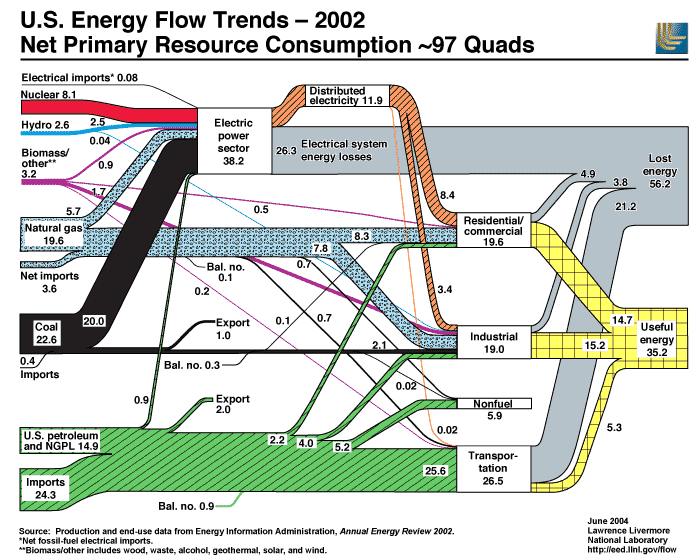
Click on image to see larger version of it.
Automotive engines have similar energy losses. About 65% or more of gasoline’s energy is lost in waste heat. This is simply a limitation of internal combustion engines. Also, when you take into consideration that the end result is often transporting a single person, you can make an argument that the energy to move the entire vehicle’s gross weight is wasted because if you’re moving nearly 3000 lbs of vehicle to transport a 170 lb. person, you’re wasting over 90% of the energy. So ‘efficiency’ is not a very easy concept to describe, let alone mandate or regulate. You could also make the argument that a lot of transportation, such as leisure travel, is unnecessary and therefore inefficient and should be outlawed.
Another thing to consider is that when you make something more efficient, it lowers its cost and people end up using more of it because they can afford more of it. So chasing after efficiency often results in increased overall consumption.
I think it is important to listen to people whose viewpoints are well researched, yet sometimes contradictory to my own. That’s how I learn. If you only pay attention to people telling you what you already know, or think that you know, you cannot become any better informed. So even if you are a self-proclaimed tree hugger, it would
be a good idea to pick up this book and read it, so that you may better understand why everyone doesn’t believe the same things that you do. It may not change your point of view, but at least you’ll be able to evaluate the veracity of the logic behind the assertions the authors make in the book.

The last 3 restrictions aren’t really necessary because the alternatives wouldn’t be practical on an aircraft that met the first 3 restrictions.
There are a number of ‘old school’ tube and fabric aircraft that meet these conditions such as the venerable Piper Cub and Aeronca Champ. Those are very simple, low and slow flying aircraft, made with 70 year-old technology. There is also a newer category of modern planes designed explicitly for the LSA category with sophisticated technology and modern construction materials. That class of LSA aircraft is the most interesting to me. A few examples include the Evektor SportStar and the Flight Design CTSW. In addition, over the past year, well established, reputable aircraft companies like Cessna, Cirrus, and Van’s Aircraft have all introduced new aircraft targeted specifically at the LSA category.
In addition to the LSA aircraft, a new type of pilot certificate has become available called the ‘Sport Pilot’ that is a match for these new aircraft. It should be much less expensive to get a Sport Pilot certificate because there is less training required. Only 20 hours of training is required vs. 40 hours for a Private Pilot Certificate. I should mention that the minimum hour requirements are not realistic for everyone so you may need to double them before you’re ready for a check ride with an examiner.
Here are the privileges/restrictions for the Sport Pilot certificate:
The last issue is the big one. I’m sure that many pilots would consider restricting their flying to LSA aircraft if they had a medical condition that didn’t hamper their piloting abilities, yet jeopardized their ability to get an FAA medical certificate.
There are plenty of ways a pilot can lose his medical certificate. For example, my friend takes a sleep medication that is on a list of ‘cannot fly if taking this medication’ because it’s also used to treat people who have seizures. He’s actually safer taking the medication because it makes him feel more rested. Although he has never had any seizures, if he tried to get a medical and reported that he was taking that medication, he would be denied his medical and might never be able to fly again. The Sport Pilot certificate has a kind of catch-22 in that regard. If you’ve ever been denied an FAA medical certificate, you cannot get a Sport Pilot certificate. However, if you simply let your medical certificate lapse when you have a medical condition that could get you denied, then you can automatically become a Sport Pilot.
Of all the people who start to learn to fly nearly 70% quit, primarily because of the amount of time and money required to get a pilot’s certificate. Of those who do finish, many stop flying for cost reasons since owning or renting aircraft can be quite expensive.
So perhaps the GA renaissance has merely been delayed, or at least that is my hope. I will revisit this posting in the future and see if the LSA category for aircraft and the sport pilot certificate has reversed the downward trend in the number of people holding pilot certificates. In the 1980s, we had over 800,000 pilots in the U.S. and now it’s just slightly under 600,000. Judging by the age of the average pilot, reversing that trend is going to be quite a challenge but reducing the cost and time to obtain an entry level pilot certificate is a step in the right direction.
The 4 radios look dissimilar enough that they might have been designed by 4 different companies. I don’t know what they are thinking at Yaesu, but giving products two different numbering schemes and using another brand name without the name recognition of Yaesu isn’t really helping them in any way.
When it comes to aviation handhelds, it would be better to have a high end model and a low end model with similar user interfaces and accessories that are common. In addition, it would help if the people who staffed the Yaesu trade show booth actually knew something about the products. This has been an issue for the past several years. The guys are neither hams nor pilots and they don’t provide any staff to the larger vendor booths. I began feeling so dismayed by this inept marketing approach that I started looking more seriously at the competition, namely ICOM.
ICOM made a big splash this year with a new panel mount radio called the A210 which, unfortunately, appears to cost about twice what their current A200 radio and doesn’t really do much more. ICOM had been the price/performance leader in aviation panel mount radios for many years with the A200. It costs approximately half of what the competition charges for a similar radio.
The venerable A200
I don’t know why the components that can be sold in a handheld radio need to cost 8 times as much when they are wrapped in a few more dollars of aluminum and have fewer features, but that is the case with nearly all panel-mount aviation radios.
ICOM currently produces only 2 aviation handhelds, the A6 and A24, which look identical. The only difference is that the A24 has the NAV feature, and the A6 does not. In talking with their reps, they claimed that they designed the radios using focus groups with real pilots and found that the 3 most requested features from pilots were:
Ease of use for this kind of radio is important since it’s a backup radio used infrequently and you don’t want to have to refer to its manual during an emergency like a complete electrical system failure. The backlit LCD display is easy to read as are its backlit keys.
The battery takes up more than half the mass of the radio giving its battery life an advantage over attempting to make the radio as small as possible and compromising battery life in the process.
After mulling this over for a while and considering the discounted show price and a $40 rebate, I decided to switch camps. I bought the A24 and so now I’m an ICOM owner again, something that I haven’t been for more than 25 years.


Recent Comments