-
The LightSquared Debacle in Layman’s Terms
Posted on October 13th, 2011 6 commentsI’ve been reading about the LightSquared debacle for months. My aviation-related e-newsletters and magazines have been covering the GPS industry’s objection to LightSquared and how it would be disastrous for the GPS receivers, essentially causing a loss of satellite lock or at minimum causing accuracy issues that could lead to disaster. The story received a boost in interest when it was found that there was some political chicanery associated with the White House administration pressuring a reversal in the testimony of an Air Force general. It’s hard to ferret out the underlying reason how this problem got this far, with so much money being invested in a technology that LightSquared should have known would hit a wall during its deployment, namely when it produced interference with a critical service like GPS that is adjacent to its bandwidth allocations. So I decided to do some research and summarize it here.
The problem of radio interference isn’t new. The FCC and similar organizations in other countries were created primarily to help prevent interference problems by licensing radio spectrum and settling disputes among the radio spectrum’s users. All radio transmitters generate some amount of radio frequency (RF) energy on adjacent bands. All receivers are influenced by signals that are in adjacent bands because there is no such thing as a perfect filter to ignore nearby signals. So one must ask the question, is this an interference problem on the part of LightSquared, or a susceptibility problem for the GPS manufacturers? And since there is no such thing as a perfect filtering technique, how much can it help to apply filters to GPS receivers? Can the problem be solved with a 5-cent change to GPS receivers as suggested by LightSquared, a solution promptly dismissed as absurd by the GPS industry? I can tell you one thing that does not work, and that is to expect an industry to accept a problem introduced by some third party AFTER its products have already shipped and are in the hands of its customers. Sure, you can ask for a change to future products, assuming the change actually produces the desired result and isn’t too costly, but if an industry is entrenched, and I think that after 2 decades of shipping millions of products, GPS can be categorized as such, you can’t expect them to accept a problem that wasn’t a problem until your service came along.
Nor can you expect all existing customers to ‘upgrade’ their equipment just to solve some newly introduced interference issue. Yet this is apparently what LightSquared was expecting. And I find that attitude arrogant and ridiculous. Anyone whose money is invested in a technology that expected such a system to work should expect to see his investment lost by those who dismissed or talked around these issues when they were first brought up.
One might tend to lay the blame on LightSquared and its naivete, but I think the FCC is just as culpable. The FCC needed to realize that any service that occupied frequencies adjacent to GPS must necessarily be compatible with it. GPS satellites transmit signals from a distance of about 12,500 miles above the earth. Because of this vast distance, the signals are at a very low level once they arrive on earth, about -130 dBm (which is about 180 x 10^^-18 Watts). The land-based LightSquared 4G transmitters can use as much as 70 dBm (10,000 Watts). So you can see that there is a vast difference of roughly 2 x 10^^20 in signal strength between the two services. The low signal strength is one of the reasons why most Space-to-Earth signals require dishes or other types of high gain antennas pointed at the satellites to amplify only those signals and simultaneously ignore any signals originating from other directions. But GPS receivers cannot do that. First of all, the constellation of 24 satellites is in constant orbiting motion, and secondly, a GPS receiver needs an antenna that can receive from several satellites at once in order for it to do its job so it cannot use a directional antenna. A GPS receiver has none of the amplification and signal isolation benefits provided by a directional antenna. This means that the signals that a GPS receiver has to deal with are extremely weak, and are actually below the noise floor, and must be dug out of this noise floor using sophisticated signal processing techniques.

As shown in the graphic above, (source) the bands adjacent to the GPS spectrum were intended to be used for similar purposes, that is to send signals from space to earth or earth to space, and based on what I’ve been reading about LightSquared, this was how they intended to use the spectrum initially. But most broadband solutions that depend on satellites are not very compelling due to the 44,000 mile round trip the signals they need to make to the geosynchronous satellites. This trip adds about a half second delay which is too high a latency to provide a satisfactory experience compared with terrestrial broadband solutions, especially with modern Internet applications some of which cannot tolerate that kind of latency. People tend to use satellite broadband only when there are no terrestrial broadband offerings in their area.
In 2004, presumably to make its service more financially attractive, LightSquared’s predecessor lobbied for and received authorization by the FCC to deploy thousands of land-based transmitters in the same frequency range as their satellite-to-earth band. I think that this authorization from the FCC is where things went awry. LightSquared, when it was a space-based wireless service that could hypothetically offer 100% coverage over the U.S. had a formidable calling card, namely that it could provide mobile wireless service to previously under-served rural areas. Telling a government bureaucrat that you’re going to provide ‘service to rural and the under-served’ is tantamount to telling them you’re going to cure world hunger or help the blind to see. Everyone knows there is little or no profit in serving the under-served, it just makes for a good story to soften up government bureaucrats so they’ll grant you favors. Indeed, earlier this year, the FCC allowed LightSquared to offer devices with just the terrestrial capability, making them nothing more than just another mobile wireless provider, which might be viewed as a clever bait-and-switch maneuver since those devices would no longer have the large size and expense of a hybrid phone. This would allow them to rake in some real profits by taking business away from the incumbents of lucrative mobile wireless services rather than being just some quirky satellite phone and data service.
So more than any other factor, it was the decision to take its space-based frequency allocation and have the FCC re-authorize it for terrestrial transmitters that made it incompatible with GPS receivers. Even a very low-power transmitter that is in close proximity to a receiver will have signal strength that is many orders of magnitude stronger than one that is located 22,000 miles away. But if you can influence politicians by explaining away the problem, and hoping that the GPS industry looks upon it as an opportunity to force their customers to purchase new receivers that deal with the interference, then it would be a win-win for all parties, except those who have to buy new GPS receivers, namely consumers, who have no lobbyists to protect them. But it appears that all the hand waving about potential technical solutions may not make the GPS interference problem go away. There may be no filtering technique available at any cost that would fix it and still allow a GPS receiver to maintain the accuracy customers rely on. And so, in order for a company and its investors to enrich themselves, they appear to have no qualms about completely destroying another much larger industry that provides an invaluable service to many sectors of the economy. Some might think of this as free market capitalism. I think of it as sociopathic behavior so extreme that it makes me ashamed for the company and the politicians who did the company’s bidding.
I have to wonder whether it’s even possible to provide an economical hybrid mobile wireless device that can be used with geosynchronous satellites and land-based cells. Iridium provides mobile phone service based on satellites, although that service nearly went broke and was only revived when its multi-billion dollar investment in satellites was picked up for pennies on the dollar. But Iridium is a completely different technology since its satellites are in low earth orbit, just 485 miles above the earth, and so the distance is about 2% as far from the earth as a geosynchronous satellite thereby requiring much less power from the mobile device to establish a connection. But these phones and service are very expensive compared with standard mobile phones. The phones tend to be large and bulky and cost upward of $1200. The service is metered at $1.30/min or more in addition to a $50 monthly fee. Compared with standard mobile phones this would not be a competitive offering, so getting the go-ahead from the FCC to have terrestrial transmitters was a key win for LightSquared because a phone that communicated with geostationary satellites would be very large, power hungry, and costly.
The amount of power and antenna you’d need to communicate with a geosynchronous satellite would be difficult to implement in a handheld device that fits in one’s pocket, if it could be done at all, unless they intended for it to go through some form of a roof-mounted gateway. But then it wouldn’t really a true hybrid mobile device as this service had been promoted. And you couldn’t use a satellite handset from inside a car or house without a roof-mounted antenna and transceiver due to blockage of the satellite signals, making the service appear like something that may feel like a throwback to 1980′s technology.
Hughes has offered a satellite/terrestrial mobile phone solution called GMR1-3G for some time. The hardware looks like something you’d need if you were deployed to some remote corner of the earth. In fact, LightSquared initially had planned to use that service before switching to something called EGAL which stands for Earth Geostationary Air Link from Qualcomm. EGAL appears to be some new hypothetical hardware/service that has yet to be deployed. Interestingly, Qualcomm is the company that came up with the estimate of 5 cents for the filter that would fix the GPS issue.
It is usually not a good sign when a company gathering large sums from investors is basing its future success on a yet-to-be proven technology while simultaneously ramrodding its agenda by forcing a government agency to grant approval and thumbing its nose at its spectrum neighbors. These folks need a wake-up call. Maybe the sound of a few billion dollars of their investment swirling around a drain will provide that wake up call for Lightsquared and its investors and anyone foolish enough to embark on a similar venture in the future.
UPDATE (2011-11-11) If you would like to know more about the testing that was done that showed the significant interference on GPS receivers, the Coalition to Save our GPS has a complete list of test reports on their website. The summary is that during these tests, nearly all GPS devices tested couldn’t receive a signal when they were within a few miles from the tower, even though the LightSquared transmitter was operating at 10% of the power they would be permitted to use. In addition, LightSquared claimed that if they simply moved their signals to the first 10Mhz of their allocated bandwidth, then 99% of the GPS receivers would not have been affected, even though there is not a single shred of evidence from this test that would support that claim.

-
Commuting Like George Jetson
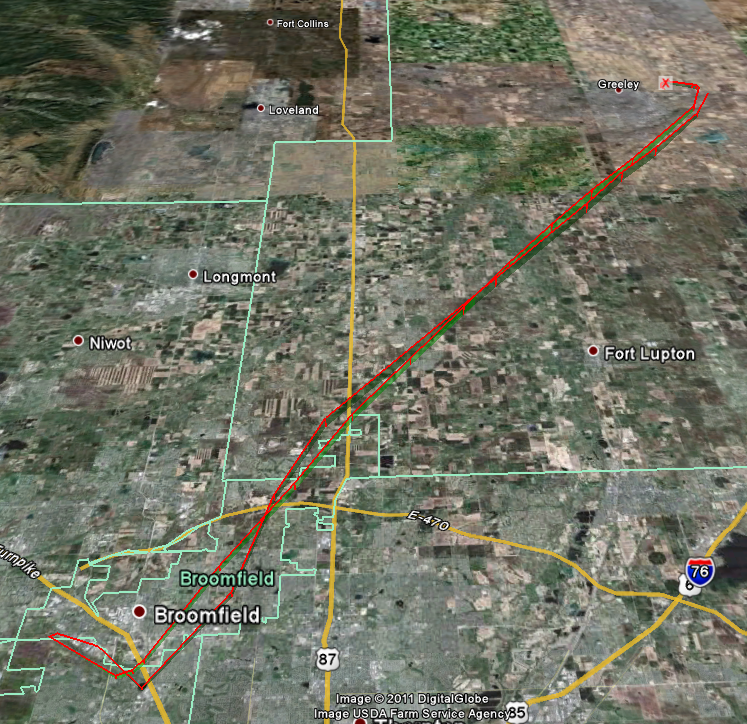
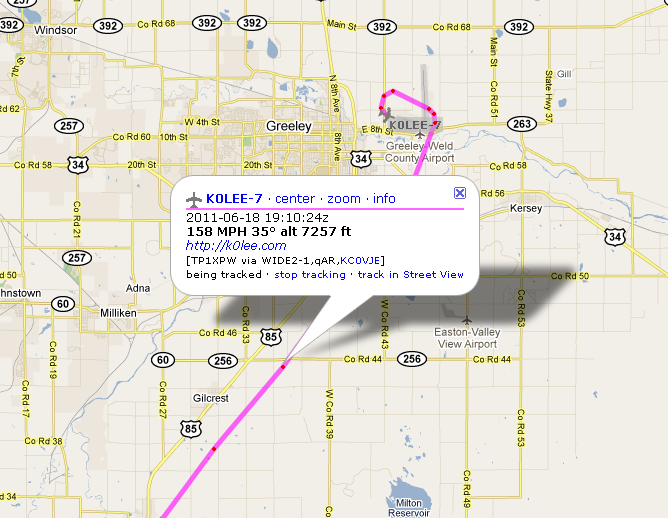
Posted on June 22nd, 2011 6 commentsI knew from watching the cartoon, The Jetsons that when I grew up, commuting would be fun. Surely, by that time all the technology showcased on that cartoon would have arrived. But sadly, much of the Jetsons technology is still missing, especially the flying cars. But lately, I’ve been using George Jetson’s approach to commuting that has made a 108 mile round-trip commute that I do several times a week not just tolerable, but enjoyable.
Here are a few rules I follow to make my commute more enjoyable:
- Ignore roads, travel in a straight line.
- Don’t take a route that has traffic lights, stop signs, or other commuters.
- Travel at twice the maximum speed limit, say, 150 mph or so.
- Stay 2000′ above other commuters.
I guess you can tell by the images that I’m talking about commuting using my airplane. This works for me because one of my consulting clients is based at an airport so I don’t need ground transportation after I arrive. One of my colleagues actually lives on an airport, so he has the benefit of commuting door-to-door using his airplane alone. I have to drive 10 miles to the local airport first before I can hop in the plane…. but if I could only figure out how to take off from my back yard….:-)
-
Bear Chews up Plane, Duct Tape to the Rescue
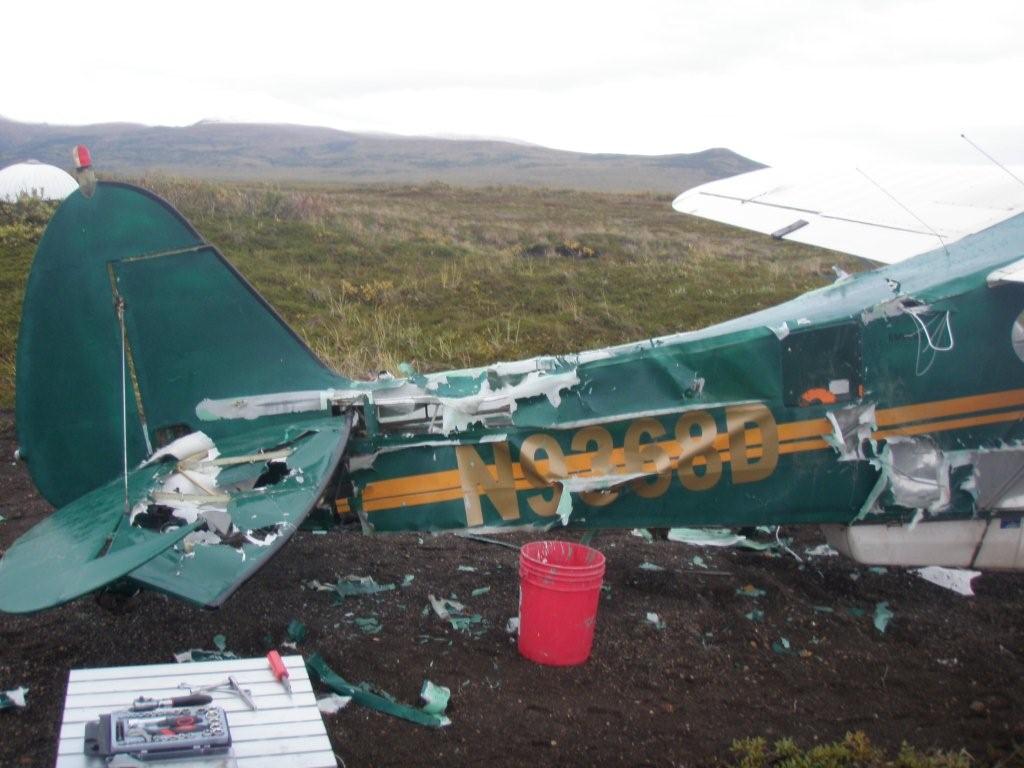
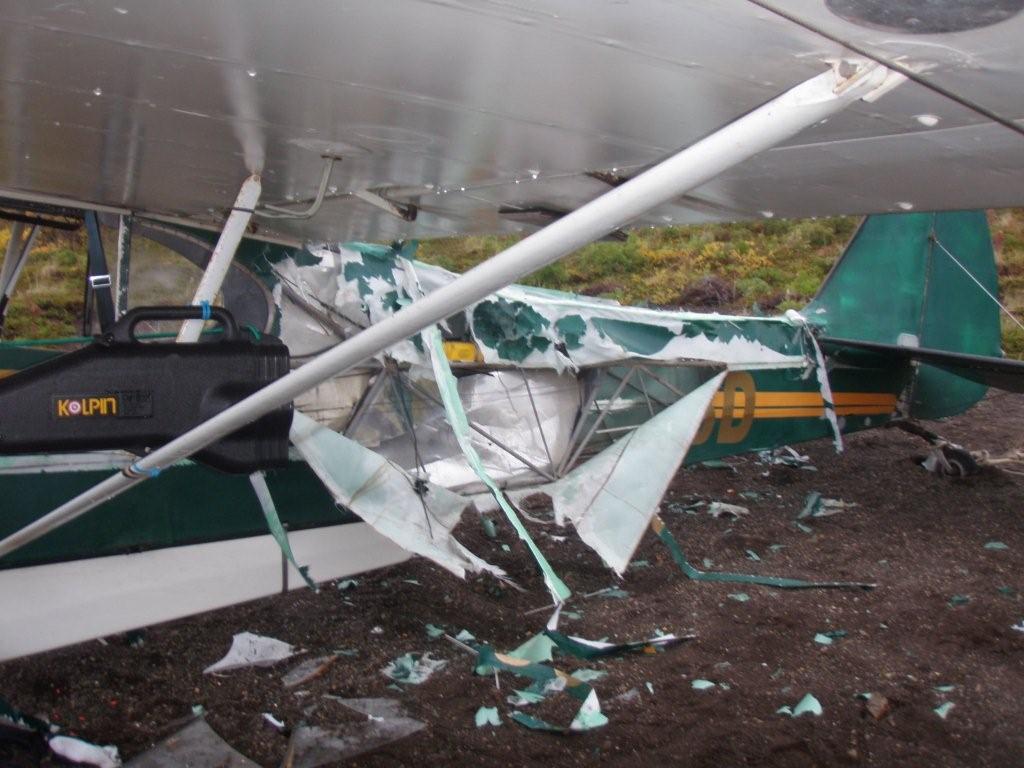
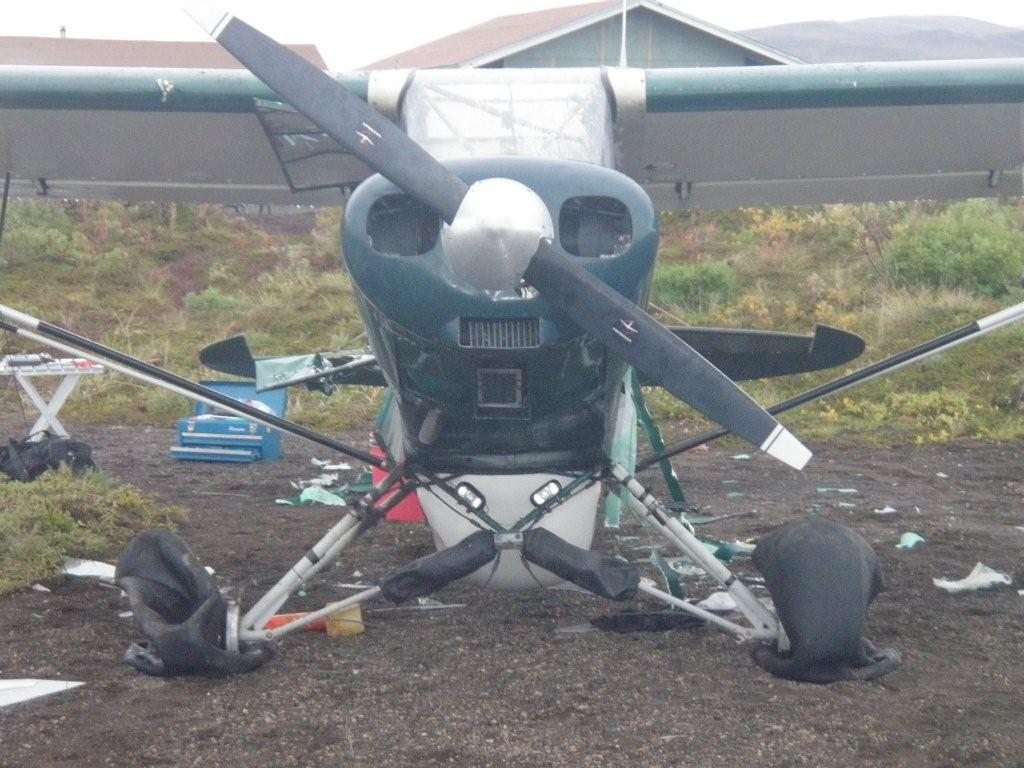
Posted on January 6th, 2010 No commentsI am amazed at the resourcefulness of Alaskans. During a private “fly-in” fishing excursion in the Alaskan wilderness, the chartered pilot and fishermen left a cooler and bait in the plane. And a bear smelled it. This is what he did to the plane, a Piper Super Cub.
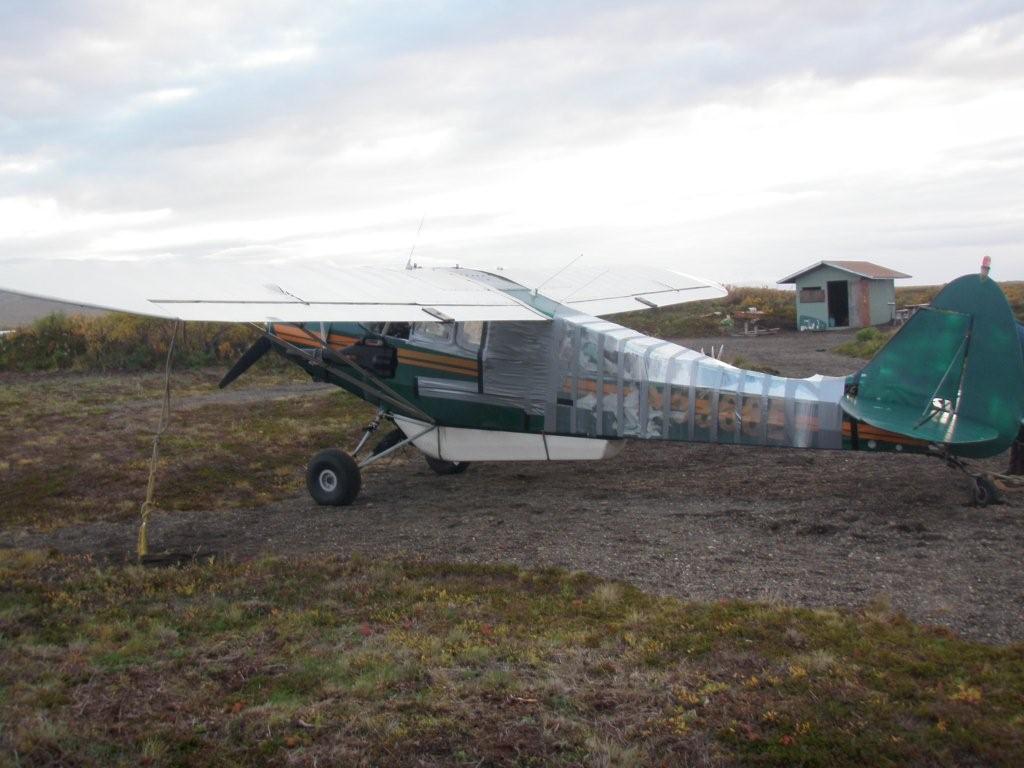
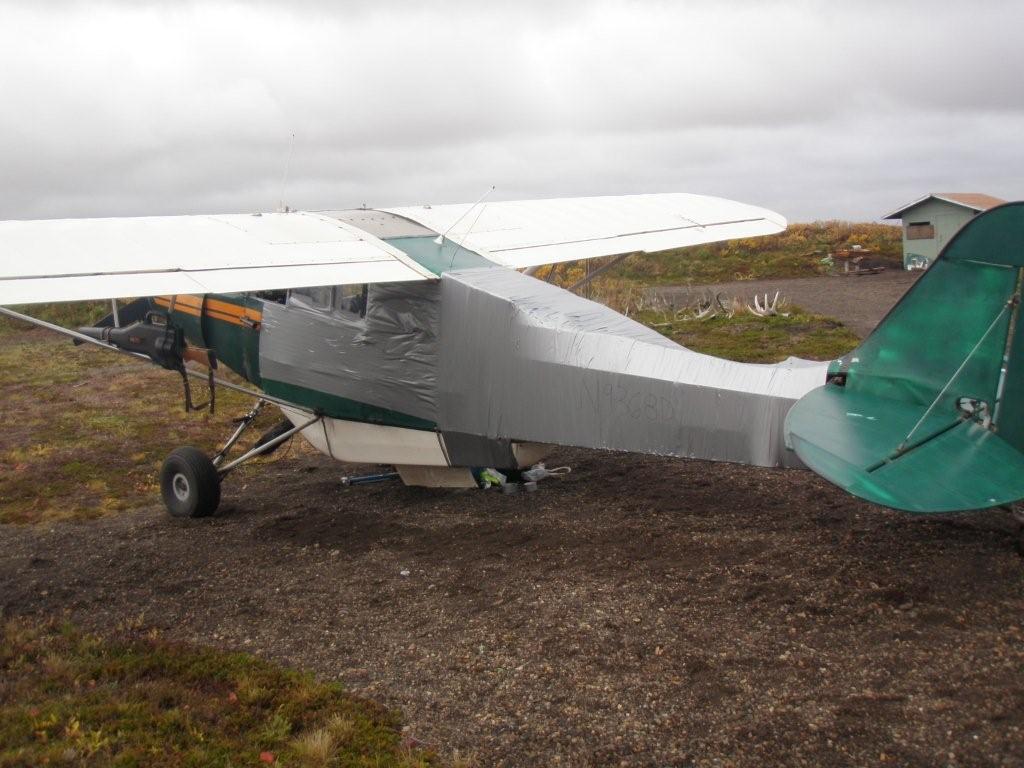
The pilot used his radio and had another pilot bring him 2 new tires, 3 cases of duct tape, and a supply of sheet plastic. He patched the plane together, and FLEW IT HOME!
Click on any image below for a higher resolution version.
How would you like to come back from a day of fishing to find this?
The bear destroyed a plane… all for some bait fish…
And a few tasty tires…
Looking good!
I like the way he ‘kept it legal’ with the tail number written by hand on the duct tape. You have to click on the image to get a bigger view and squint to see the tail number written over the duct tape, N9368D.
-
Barnstorming and other Adventures
Posted on December 10th, 2009 No comments
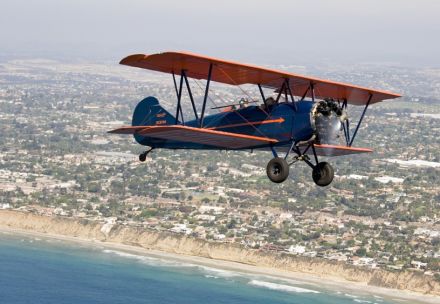
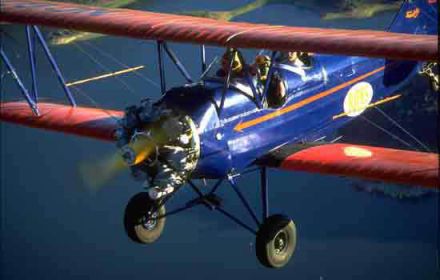
I once shared a hangar with this beautiful 1929 Travel Air. About 20 years ago I learned to fly at the New Garden Airport in southeastern PA. Shortly after getting my license, I purchased a 1961 Piper Colt. Not long after I purchased it, this amazing aircraft showed up in the adjacent hangar. The plane had been purchased by a young lady who quit a secure job and started a barnstorming business with a business partner giving rides in an open cockpit biplane. I was amazed to think that someone would leave a secure job and start a business like that. Later on when I was exposed to Richard Bach’s books I felt like his stories might have inspired the couple to throw caution to the wind and start that business.While reading the Slashdot feed yesterday I saw a reference to a site that was exposing the Internet get-rich-quick schemes that are so prevalent these days. The article referenced a website called undress4success.com. Despite the attention-getting title, I learned that it was dedicated to providing useful information to people who are working from home. It provides resources to help people who like the idea of a 2-second commute and the site’s owners regularly gave the low-down on scams that prey on those hoping to make a living working from home. The most recent article was related to the ‘Work for Google’ scams that are being actively pursued by Google’s legal team, since they are not endorsed or supported by Google. The scammers are just trying to profiteer from pretending to have an association with the Internet search giant.
I like to expose scammers. Seeing unscrupulous charlatans abuse the goodwill and trust of others is just one of those behaviors that I can’t sit by and idly watch. Several of my most popular blog articles are related to exposing scams like the Amish Heat Surge miracle heater, the Arctic Cool Surge (yes, same company), and exposing the unworkable mathematics of all MLM schemes.
I was reading through the website and I started to realize that the couple running it had a very familiar-sounding story. They mentioned that they had started a Barnstorming business in Pennsylvania in the early 1990′s, moved it to San Diego, and then grew it to 7 aircraft and 25 pilots before selling it and starting this new website and promoting their book entitled Undress for Success: The Naked Truth about Making Money at Home which is about how to work from home. It was Kate and Tom, the same couple I had met at New Garden Airport, all these years later! It’s certainly a very small world.
I had been working on my own article about people who make money by selling others on the idea of how to make money on the Internet. The funny thing is that many of these sites are all writing about the same thing, which usually involves selling ‘secrets’ or starting an endless cycle of recruitment for information products. It sounds a lot like an abusive MLM business. The kingpins in the worst MLMs don’t actually make their money selling products, they make their money selling high-margin ‘educational materials’ and ‘tools’ to unsuspecting recruits month after month. This is precisely what these get rich quick membership sites (who generally want a direct line to make a monthly withdrawal from your bank account) are up to. When it’s all said and done, they sell you on a business that is nothing more than a recursive cycle for you to try to write and sell the same kind of information on the Internet. But who wants to buy from you when they can go right to the source, i.e., the guy holding up an image of his big earnings check on every one of his pages? They augment this income with a other questionable affiliates all who have something to sell you that sounds like it will teach you to get rich quick. Or, if not that, then information on how to get flat abs, or get ripped like Arnold Schwartzeneggar in 4 weeks.
I just purchased the book based on the positive reviews I’ve read on Amazon. Websites that educate people on the perils of scams tend to restore my faith in humanity and I always feel good when I come across one.
And if you can’t live without a ride in the vintage Travel Air, you can find it at Barnstorming Adventures (phone: 800-759-5667) located at Montgomery Field Airport in San Diego flying under the new ownership of another couple who no doubt purchased the business as an insurance policy… an insurance policy against a boring life.
Remember, if something sounds too good to be true, it probably is, and on the Internet, that goes double.
-
Channeling Steve Fossett
Posted on October 11th, 2008 No commentsBecause I’m a pilot, I often get asked to speculate on the causes of plane crashes where there’s not enough evidence to know for sure what really happened. Such is the case with Steve Fossett where I get periodic requests to give my opinion about what happened in his mysterious disappearance in a borrowed airplane. Just for those who haven’t been paying attention, Steve Fossett was a wealthy adventurer who set numerous aviation records including traveling around the world solo in a balloon as well as flying an airplane solo without refueling around the world. He took off on a sightseeing flight from Barron Hilton’s Ranch in Nevada last September and was never seen again. Just a few weeks ago, more than a year after he disappeared, some of his personal effects were found by a hiker about 80 miles from the ranch where he had departed. Shortly after that, the crash site was discovered in the Sierra Nevada mountains.
A recent Avweb newsletter linked a set of pictures on Flickr posted by one of the SAR team members who helped clean up Steve Fossett’s crash site. There are about 10 pictures in the middle that show parts of the plane that start right around the one with the newspaper clipping image.
What I found interesting was the caption on the photo 43 that mentioned that the plane impacted the ground climbing at about a 10 degree angle on a slope that was at a 20 degree angle leading me to think that Fossett may have had a problem with the airplane and so he tried to land by attempting to climb uphill and get the aircraft to stall right around the time it contacted the ground. A ‘roll out’, if you want to call it that, on a 20 degree slope uphill would be pretty short. However, there were a lot of rocks and trees and so it appears that the plane broke apart on landing and then was consumed by fire. To make that maneuver work, you would have to do it ‘just right’.
At an EAA chapter meeting last night, someone mentioned that Bob Hoover performed this maneuver where he knew he was going to crash and so he did it going up hill and he and his passengers walked away from it. Here’s that story, excerpted from my (autographed) copy of Bob Hoover’s autobiographical book “Forever Flying”.
One of the more frightening experiences I’ve had occurred after an air show in 1989 at San Diego. It was held at Brown Field, which is located just a few miles from the Mexican border.I had completed my performances in the P-51 and the Shrike Commander. I told the line boy who drove the fuel truck to service the Shrike quickly so I could leave right after the show was completed.
The young man asked how much fuel I needed. I told him I wanted precisely sixty gallons. I added, “That’s hundred octane.”
After my performance, I went to the manager’s office, where he received a phone call from the same young man. The manager told me the boy wanted to know if 100 LL (low lead) was all right for my airplane. I told him it was. He relayed the message.
Normally I like to be present when the airplane is being serviced, but I was held up when I came out of the airport manager’s office. By the time I got to the airplane, the truck was pulling away. I said, “Fueling done?” The boy replied, “Yes, sir. It was sixty gallons precisely.”
When I taxied out, probably at least a hundred airplanes were waiting for takeoff. But as soon as I called in, the tower said, “Mr. Hoover, we want you to taxi to the head of the line.”
I did not like to leapfrog ahead of other pilots. However, since time was scarce that day for me and my two passengers, I accepted the tower’s kind offer.
The takeoff was smooth. Everything was normal and checked out perfectly. All of a sudden, at about three hundred feet, I realized I didn’t have any power in the Shrike. I started losing airspeed.
I dumped the nose, but I couldn’t understand what was happening. Everything checked out. The manifold pressure was right where it was supposed to be. The rpm were at the right setting. The fuel pressure and oil pressure were in good shape. Even though the gauges indicated that nothing was wrong, I knew something was. I started looking for a place to land. That would not be easy.
Brown Field is located on a plateau. To the north where I was headed, there were deep ravines. I could try to recover and head back to the airport, but I knew I wouldn’t make it.
My two passengers tried to remain calm, but they were obviously frightened. Both thought we were going to crash and die. “Mr. Hoover,” they asked more than once, “are we going to make it?” I assured them we would.
As I have mentioned before, each time potential disaster strikes, I rely on my experience of anticipating trouble to help me out. I had flown the P-51 cross-country for many years. I’d often considered what might happen if I had to put it down over the Rockies.
Recalling those thoughts, I dumped the nose of the Shrike. I kept my best glide speed until I reached the very end of the ravine. Landing in the bottom of the canyon meant no survival. Our only chance was to pull up and land on the side of the ravine.
As my airspeed bled off, I dropped the landing gear and flaps. I wanted to be at a minimum forward speed on impact. The landing gear would cushion the impact along with the tires and struts before the impact hit us square on.
I was down in a V-shaped ravine. A thousand feet wide at the top, it narrowed down to nothing at the bottom. I went right to the bottom to maintain the best glide speed. I then pulled the plane up and landed into the side of the ravine. I didn’t travel very far at all before I hit a rock pile that caved in the nose. The instrument panel was torn out of its mounts and dropped down on my shins.
Neither of my passengers was hurt, but there was one fatality. We ran over a rattlesnake with the belly of the airplane when the gear tore out from under it.
We sat there awaiting rescue. I considered what had caused the lack of power. Only one thing was possible: the plane had been serviced with jet fuel instead of gasoline.
To confirm my suspicions, I went around to the side of the airplane and opened the drain valve. I leaned down and took a whiff. Sure enough, it was jet fuel.
My mind flashed at once to the young man I had asked to service the airplane. He must have known by then what had happened as I had informed the tower of the emergency.Within minutes, rescue helicopters were on the scene. My passengers and I climbed up the ravine and were transported back to Brown Field.
After making sure the Shrike would be protected from theft, I asked, “Where is the line boy who serviced the plane?”
Everyone seemed reluctant to tell me, apparently afraid that I wanted to chew him out or be unkind to him. Finally, someone said, “He’s outside.”
An article in the Fullerton (Calif.) News-Tribune the next day quoted me regarding what happened next:
When I got back to the field, I saw the boy standing by the fence with tears in his eyes.
I went over and put my arm around him and said, “There isn’t a man alive who hasn’t made a mistake. But I’m positive you’ll never make this mistake again. That’s why I want to make sure that you’re the only one to refuel my plane tomorrow. I won’t let anyone else on the field touch it.”
Just as I said, I had the boy refuel my P-51 for the final two days of the air show. Needless to say, there were no further incidents.
Shortly after that, I received a wonderful letter from a doctor in Palos Verdes named William Snow.He wrote:
I wanted you to know that I was quite touched by the apparent casual way in which you trea
ted your unfortunate incident. Thank goodness it was just that and nothing more! However, what really impressed me was your genuine concern for the young man who had serviced your plane.It is rare to find a person who has just experienced such a close brush with death and yet feels such compassion for his fellow man. God surely must be your copilot!
I could have just cut off that excerpt at the part where Hoover crashed, but I was so impressed by how he treated the line boy, that I’m sure you all wanted to hear how it ended.Another interesting photo is of the Google Earth map below that shows where the shirt and ID were found. They appear to be about .7 miles from the wreckage. I can only assume that those items may have gotten carried away by animals.
The NTSB report has very few details so far, but I’m sure that it will accumulate more details about the crash as they start to examine the wreckage.
We may never know what happened, but it’s obvious a fire ensued after the crash. Had the fire started while he was flying? If so, was he attempting to get the airplane on the ground as quickly as possible using the famed Hoover maneuver? We may never know, but I am eager to see what the NTSB has to say about it after they spend some time examining the wreckage.
-
Remembering Geoff Peck
Posted on July 18th, 2008 3 commentsA few weeks ago, my friend and helper on the HP Media Vault Yahoo Group, Chris, was asking me some questions about taking his first trip to the EAA convention in Oshkosh this summer. Chris found me through my Media Vault website and it turns out that we share a lot of interests. He was the first Media Vault owner to compile the Linux kernel which impressed me because he had no prior Linux experience and was only 14 years old at the time. He’s been a highly valued source of help in providing product support and also runs his own Yahoo Group called Hacking the HP Media Vault. He even runs his own computer repair business. Look him up if you’re in the St. Louis area and need some computer help.
One of the interests we share is aviation. The annual EAA convention at Oshkosh, called Airventure, is coming up next week and Chris is planning to attend it with his dad. He was asking some questions a few weeks ago about the byzantine pricing schemes the EAA uses for admission and was having some trouble trying to figure out if his junior membership qualified him for a guest admission pricing for his dad. He wasn’t getting anywhere with the folks at the EAA since it was an unusual request. Most junior or student members have at least one parent who is a member of the EAA and so the people who staffed the help desk hadn’t encountered a situation like this before. I figured that I would call upon someone who I knew who helped write the Airventure admission software for the EAA, Geoff Peck, to help sort things out.
Geoff Peck and I go way back. Geoff was the originator of Usenet’s rec.aviation subgroups back around 1992. Prior to that, there was a single rec.aviation group of which I was an avid reader and occasional contributor. I always admired the way Geoff answered aviation-related questions. His responses were always so well-reasoned and professional. Always calm and authoritative, his writing style was what I aspired to sound like when I wrote.
It had been a few years since I had communicated with Geoff. At one time, he used to organize daily meetings for lunch at Oshkosh, with everyone meeting at the base of the control tower around noon. He’d also help organize a dinner at the Granary, and he’d pass around his laptop for people to use to make a rec.aviation posting entitled “Live from Oshkosh”. This was back in the early 90′s, which was long before the Internet and Web became mainstream. It was even before Deja News (now Google Groups) began archiving the Usenet postings, so much of this history is lost to time. I would look forward to seeing Geoff each year, manning the booth for his flight planning company, Enflight, patiently talking with customers and eager to help other pilots.
So, I did a quick Google search on his name to get to his personal website and make sure I had a good email address for him. You can imagine my concern when the first hit Google returned was entitled: “Remember Geoff Peck” at his personal website. I read with dismay that he had died in a plane crash in Colorado on his way back from Oshkosh in August, 2006. I read the NTSB report with astonishment that Geoff, a highly skilled 4400-hour ATP-rated flight instructor, would perish in a classic box canyon trap.
Today I was reminded about the incident again when I got an email from the AOPA describing his accident. Here is the text of it:
“On Aug. 7, 2006, the pilot of a Piper PA-28R-201 Arrow was returning to California after attending EAA AirVenture in Oshkosh, Wis. While attempting to navigate through mountainous terrain northwest of Salida, Colo., the pilot made a wrong turn and flew into a box canyon. Unable to outclimb the terrain, the aircraft struck a stand of pine trees and came to rest inverted. The crash killed the 4,400-hour airline transport pilot and seriously injured his passenger.Making their way west from Oshkosh, the San Jose-based pilot and his passenger had arrived at Harriet Alexander Field (elevation 7,523 feet msl) in Salida around 8 p.m. on the day before the accident. The following morning, the pilot used his laptop computer to obtain a DUATS weather briefing and file a VFR flight plan to Milford, Utah. The density altitude in Salida that morning was about 9,400 msl, meaning aircraft flying in the area would perform as though they were about 2,000 feet higher than their actual altitude.
According to the airport manager, the pilot asked which route he should take to Utah. The pilot wanted to fly west across Monarch Pass (elevation 11,312 feet msl). The manager suggested that he instead fly south through the lower-elevation Poncha Pass before turning west. The pilot ignored the advice. The airplane took off around 10 a.m. and turned toward Monarch Pass.
The Arrow flew west along U.S. Highway 50, which eventually runs through Monarch Pass toward Utah. Over the town of Maysville, however, the pilot began following County Road 240, which runs northwest through a box canyon for about 10 miles before dead-ending near the canyon’s terminus.
Several witnesses saw a low-wing, single-engine airplane flying northwest up the canyon. One witness, located about two miles from the accident site, went to investigate when the aircraft failed to fly back out. He discovered the wreckage and the lone survivor sitting on a rock nearby. The injured passenger had no memory of the events leading to the accident.
The Arrow crashed at 10:20 a.m. at an elevation of about 12,000 feet msl. Terrain surrounding the accident site quickly rises to between 13,000 and 14,000 feet msl. The aircraft’s throttle was found in the full-forward position. The vertical speed indicator showed a climb rate of 130 fpm. NTSB investigators estimated the Arrow’s groundspeed at the time of the crash was 59 knots.
The board concluded that inadequate preflight planning and preparation caused the accident. Contributing factors were the pilot’s lack of familiarity with the geographical area, his becoming lost and disoriented, his decision to disregard the advice of local pilots, and the high density altitude, which reduced the airplane’s climb performance.
This accident illustrates the unique hazards of mountain flying. Summer temperatures can push the density altitude to heights that approach or exceed a light aircraft’s service ceiling, despite what the altimeter might be reading. Moreover, to a pilot unfamiliar with the terrain, the mouth of one canyon can look very much like another. Is it a mountain pass leading to the relative safety of lowlands beyond—or a dead end? Like the proverbial blind choice between the lady and the tiger, picking the wrong door can end very, very badly.”
I tried to imagine the decision-making that had led up to the accident and I have begun to wonder if Geoff had a weather issue like mountain obscuration and chose to fly northward to see if he could get around it. In doing so, he inadvertently followed a box canyon that he was unable to climb out of. I’m surprised that despite the mention of the AWOS weather conditions at Monarch Pass, weather was never mentioned in the cause of why, instead of flying over Monarch pass, Geoff would fly north and end up in a box canyon. The Monarch Pass AWOS reported at 9:50 a.m.:Wind, 210 degrees at 14 knots; visib
ility, less than 1/4 statute mile, light snow; ceiling, 100 feet overcast; temperature, 7 degrees C.; dew point, 6 degrees C.; altimeter, 30.82 in. HgThe accident investigation seems to indicate that he was lost, believing he was over Monarch Pass when in fact he was 8 miles north. After looking at the AWOS report, I can’t help think that Monarch Pass was not safe to fly through with a 100′ ceiling and so Geoff headed north looking for a more favorable weather conditions. It surprises me that there was no mention of the mountain obscuration as being a factor in this accident. Also, not taking the advice to use Poncha Pass is understandable too. Poncha Pass doesn’t cross the continental divide. So even after crossing Poncha Pass, it would be necessary to immediately turn west and cross the continental divide at an elevation similar to that of Monarch Pass (11,312 feet MSL).
I can attest to the fact that the Rockies can be difficult to climb over, especially in the summer when density altitude becomes a bigger factor, and with any amount of westerly wind, there will likely be down drafts making the climbing more difficult as you fly from east to west. Also, trying to squeeze under some low ceilings to clear a mountain pass can be a particularly bad idea.
We will miss Geoff, but not the final flying lesson he taught us and that is to be careful flying around the Rocky Mountains, especially when attempting to cross over them.
-
San Diego trip
Posted on July 9th, 2008 2 commentsA few days after I returned from the Rutan Brothers Birthday Bash in Mojave, Terri and I were scheduled to go out to San Diego for a vacation. I had investigated various methods of travel and decided that the LongEZ was still the most economical and by far the most adventurous mode of travel for us. Terri has accompanied me on several trips in the LongEZ. She has the dubious task of squeezing into its compact back seat beset with our baggage. It’s a good thing she’s svelte.
We’ve taken several LongEZ trips together to Illinois, Seattle, and Lake Tahoe. She also accompanied me on many trips in our Piper Colt including a 1500 mile trip from Pennsylvania to Colorado, but that plane had side-by-side seating so it was more comfortable for the passenger. It takes Terri time to get over the discomfort of long distance traveling with the LongEZ and so we don’t do it all that often, about once every 2 years. The primary motivation for finishing the Cozy, which has side-by-side seating and much more baggage space, is to make our traveling more comfortable. The seating position and visibility in a canard airplane is much better for the front seaters than for the rear seaters because they have better visibility and can stretch their legs out a lot more. It’s also a lot easier to communicate with someone who is seated along side you than it is with someone sitting behind you.
I try to break our trips up into 2 to 3 hour legs so that it doesn’t get too uncomfortable. When I fly with a passenger, I need to keep the fuel load light, no more than half full, so as not to put the plane over its gross weight and to help maintain a reasonable climb performance.
The night before we were scheduled to leave, we had a Rush concert at Red Rocks amphitheater in Denver. That meant we wouldn’t be getting home until nearly 1:00 a.m. and so we didn’t expect to leave until around 9:00 a.m.. The concert had been rescheduled from earlier in the month because of a weather cancellation so there wasn’t much we could have done short of missing it, and that wasn’t going to happen.
When flying a small airplane, if you can start your traveling at the crack of dawn, you can reduce the amount of time flying in the bumpy air that generally starts around 11:00 a.m. Unfortunately for us, it would have meant getting little or no sleep, so it wasn’t an option. We managed to get in the air about 10:00 a.m.
The climb performance of the LongEZ at gross weight with the 108 HP engine is not great and the continental divide is the first and highest part of the Rockies we needed to clear. It’s just about 15 minutes travel to the west. I have a policy that I won’t fly toward a mountain pass until I can see over and clear it by at least 500 feet well before I arrive at it. Too many pilots get in trouble as they try to out climb a mountain and that’s a formula for disaster, especially when you figure that the service ceiling for many small planes is around 14,000′ and there are mountain peaks taller than that in the Rockies. It’s possible to fly a northern route up around Laramie, WY or down around Albuquerque, NM if the plane can’t safely climb over the mountains and that would be my advice for anyone who hasn’t done much mountain flying and wants to cross the Rockies. The density altitudes tend to be very high around here because the ground warms the air at these high elevations, so a 12,000′ mountain pass may have a density altitude much higher than its elevation, possibly beyond the service ceiling of an aircraft, so you have to be aware of that when crossing the Rocky Mountains in a small airplane. Even taking off from high altitude airports can be a very strange sensation if all of your experience has been close to sea level. Planes tend to accelerate and climb much more slowly when the density altitude reaches 8000′ or more which is a very common occurrence in Colorado and other western states with high altitude airports.
We climbed over the Rockies just to the north of Long’s Peak and got a nice view of Estes Park and Rocky Mountain National Park. Our first fuel stop was in Grand Junction, near the western border of Colorado and as we approached it, the afternoon thermals were already starting to make the ride bumpy. I knew we were in for a rough ride across Utah and Arizona. We were planning to spend the night in Sedona, AZ because we had heard so much about it and had never been there. We were eager to see if it lived up to its utopian reputation. After fueling up at Grand Junction, we headed off toward Moab, Utah and then turned southward. I was hoping to cross into Arizona near Monument Valley to get a good look at the famous formations that have appeared in many western films. The terrain below us for much of our journey across Utah was a series of canyons and rugged formations made by the Colorado River drainage. It eventually turned into Lake Powell, which was visible off of our right wing. Monument Valley was just to the left as we crossed into Arizona. We were too far above and to the west of the formations to get any good pictures of them, but they all looked very familiar.
As we got further into Arizona, the thunderstorms had begun to appear on the horizon. I called up Flight Watch on 122.0 and asked about weather developing along our route and the weather briefer suggested that we fly directly west to the Grand Canyon Airport and then head south to get around some cells that had formed just east of Flagstaff and Sedona. I decided that it would be good to land at Grand Canyon Airport and take a break while we looked at a weather radar screen, just to make sure we’d be clear getting into Sedona. This allowed us to fly over the Grand Canyon, which was fun to see from the air. Terri and I had visited the Grand Canyon in 1985, just a few weeks after we got back from our honeymoon. I can still recall how hot it was driving across the Painted Desert in a car that had no air conditioning. The Grand Canyon airport had many commercial aircraft on the ramp taking tourists for scenic flights over the canyon. There were at least a dozen twin turbo prop aircraft parked there and they were leaving at a very regular rate. Most of the visitors appeared to be from other countries. After recovering from our bumpy ride, we got back into the plane for our short flight to Sedona. Flying into Sedona is visually stunning. It’s surrounded by red rock cliffs and formations of all shapes and sizes and the airport is like the deck of an aircraft carrier sitting up on a butte with 400′ dropoffs on all sides. There are many scenic overlooks around the airport and people drive up to it just to take in the 360-degree views of Sedona.
We had reservations at the Sky Ranch Lodge at the airport, and I’m glad I made them a few days in advance, because they were completely booked when we arrived. We also ran into John Lambert and his wife at the terminal. I recognized his name when he introduced himself because he had put together a slide presentation at the Rutan Birthday bash I had attended the previous week. He and his wife were on their way back to Arkansas from Mojave via automobile and had stopped in Sedona for the night. John built a Varieze but had since sold it.
There is a restaurant at the Sedona airport that serves dinner, but we wanted to see some of the town and to do that, we needed to get a ride into town. As we were walking to the hotel, we had been offered a ride into town by a kind stranger who was driving by but we only needed to walk a few hundred yards to the hotel. John Lambert had already offered us a ride to the hotel, but we opted to walk since it was so close. I figured getting a ride into town would be easy. However, the first 2 taxi services w
e called didn’t have any drivers available to take us to a restaurant so we called up a car service operated by ‘Gator’ who gladly showed up in a unique vehicle with horns on the hood and gave us a ride into town. After an enjoyable meal on the outdoor patio of the El Rincon restaurant along Oak Creek in Tlaquepaque Village, we started walking back to the center of town, figuring our odds of getting a lift back up to the airport might be better there. As we were walking, I turned to ask a woman who was walking behind us if she could direct us to the center of town. She asked where we were going and we said we needed to get back to our hotel at the airport. Without hesitating she said she was going that way and offered us a lift. It was the third ride we had been offered since our arrival.
The next morning, we had breakfast at the airport restaurant and took off around 9:00 a.m. The airport elevation is 4800′ and the temperature had gotten high enough that the density altitude was already 8000′. With an uphill departure, we used most of the runway to get airborne and I was grateful that by the time we flew off of this aircraft carrier of an airport, the town was already 400′ below us. We had to turn west to avoid the 6000′ tall cliffs just north of town.
From Sedona we flew over Prescott, then just south of Lake Havasu, Palm Springs, and on to San Diego. Upon arriving near the busy airspace around San Diego, I attempted to contact SoCal Approach to get clearance into the Class B airspace that covers most of the airports around San Diego. The controller was not responding to me and when he finally did, he told me he’d call me back in 5 minutes. My alternate airport was Ramona, which is just outside the Class-B airspace and so I started circling toward it waiting for my call. After 5 minutes with no response I called him again, and got a response that he’d call me back in another 5 minutes, all while sounding overworked and flustered. This appears to be a stall tactic used by controllers that means, “Don’t bother me, I’m busy with more important traffic right now.” The airspace over Montgomery Field, which is downtown in San Diego, was very hazy with only about 5 miles of visibility. By contrast, Ramona was clear and right below me, so I decided to land there and see if we could get the rental car delivered there instead. I called the Ramona tower, got a clearance to land and then taxied over to Chuck Hall aviation. After a few minutes on the phone with Enterprise, they agreed to pick us up and drive us to Poway to pick up a car. So that made the decision to park the plane there instead of at Montgomery Field. Even though it would have been more convenient, Montgomery Field often gets fogged in for several hours each morning in June. Ramona is far enough inland and higher in elevation that it’s not as susceptible to those conditions so I was fine with parking the airplane there while we visited San Diego.
Our Starwood Four Points hotel was next to Montgomery field and with the GPS, we were able to find our way there without difficulty. I should mention that during this trip I used my HP Travel Companion running Anywhere Map software for aerial navigation and then switched to its built in Tom Tom Navigator in the car. We found this gadget to be invaluable both in the car and plane during the trip. We used it constantly. I was even able to send email with it from a free wireless connection at the hotel.
The hotel is undergoing an extensive remodeling project and so we got a new room with a nice soft bed. It reminded us of our the bed we had at a Sheraton in downtown Chicago this past March. Later we’d find out that this bed is called a ‘Heavenly Bed’ and we’ve since put it on our shopping list.
Terri is a beach person, and one of our major goals was to visit the beaches around the San Deigo area, so after a short rest, we headed off for Mission Beach. I’ve only been to San Deigo once before, in 1984, and had visited Mission Beach so I was a little familiar with it. We strolled along the beach and took in the sights. Later that evening, we ate at a restaurant in ‘Old Town San Diego’ and did some sightseeing there as well.
Prior to arriving in San Diego, I had emailed my college roommate, Dave Serhan, who has lived in San Diego since graduating from Penn State to tell him that we’d be visiting the area. Whenever we travel in the LongEZ, I generally try to avoid setting up any meetings that would make us feel like we have to be in a particular place at a particular time. When I visit fellow pilots, they tend to understand the unpredictability of private airplane travel and so I don’t mind telling a pilot in general terms when I expect to be around, because if I show up late or not at all due to weather or some other reason, he’ll understand. Dave was the first person I knew who had his pilot’s license and he took me for an airplane ride at Forty Fort, PA airport when we were both teenagers. I still remember it vividly because he let me fly the airplane while he took some aerial pictures. It was my first experience at the controls. I guess in some ways, I have him to blame for my aviation addiction. Dave also spent much of his military career flying F14 fighter jets off of aircraft carriers, so he parlayed his investment in learning to fly small airplanes into flying multimillion dollar jets before retiring from the Navy a few years ago. I had visited Dave during my last trip to San Diego and he gave us a tour of Mirimar Naval Base and we got to see his F14 fighter jet. It was very impressive.
The following day we decided to visit Coronado Island and I gave Dave a call on my way to see if he was around or if he was off traveling for his job. Dave was home when I called and told me he only checks his home email address once a week and so he didn’t get my message. He invited us over for dinner and to meet his family. I saw Dave last year at our high school reunion, but hadn’t met his wife or daughters.
We spent the afternoon in Coronado Island and even rented a pedal-car called a surrey to travel around the island to get a better feel for the place. We really got a good workout as a result of our 6-mile pedaling adventure. Previously, I had thought that Coronado Island consisted of just a Naval base, but quickly realized that it had a beautiful beach and surrounded by many quaint neighborhoods. We ate lunch there and then went to walk on its beautiful beach that had sparkling golden flakes mixed in with the sand as it washed in on the beach. We also took a quick tour of the The Hotel del Coronado which was built in 1888, and it was quite spectacular. Terri has decided that on our next visit to the area, that’s where she’d like to stay.
After a day touring around Coronado Island, we headed up to Dave’s house north of the city. Our GPS led us right to his door. We really enjoyed getting to meet Dave’s lovely wife, Anita, and his two beautiful daughters, Lindsey and Kristina who are ages 19 and 15 respectively. Dave and I spent some time catching up while Terri and Anita became engaged in lively discussions on topics involving pets, furniture, and clothing. Anita is an expert in furniture and when we described our Starwood hotel bed to her, she immediately knew that it was called a ‘Heavenly Bed’ and that you can order one for your home. Part of its incredible comfort is a result of the high thread count sheets and blankets.
I learned that Dave has become quite a skilled pool player and is top ranked in his league. He recently built a billiard room and so I played a few games of 8 ball, all while feeling quite outclassed as he demonstrated his considerable skills. In a few hours, it was time for us to leave, but we hope to get back in the area and pay them another vi
sit. I am confident it won’t take us another 24 years to get back to San Diego again.On Sunday we decided to visit the aircraft carrier, the USS Midway, which is docked at a downtown pier. First launched in 1945, the ship has undergone several retrofits and saw action right up until Operation Desert Storm in 1992. It’s been a museum/tourist attraction since 2004. An aircraft carrier is an engineering marvel and neither Terri nor I had ever seen one up close. I’ve seen plenty of TV programs that describe them on the Military Channel, but getting to walk through one is quite an experience. It took us about 3 hours to take the full self-guided tour which included an audio recording of many of the ship’s features. I won’t go into all the details of what we saw, but there are some pictures linked below and about half of them are of this tour. If you’re ever in San Diego, I suggest you spend a few hours to tour this ship.
There were still a few beaches we wanted to check out, and so we spent the rest of the afternoon comparing the beaches in Del Mar and La Jolla with the ones we saw closer to downtown San Diego. I had ventured into La Jolla during my first visit to the San Diego area, up in the hills and was astonished at how beautiful all the homes looked. So Terri and I took a short ride up Hillside Drive to see if my recollection fit what I had remembered. We found a dream home there offered for $12.1M which looked quite nice, but a bit out of our price range.
We liked all of the San Diego beaches, and Coronado was our favorite because it seemed the most accessible and the least crowded.
On Monday morning we headed home, taking off around 8:00 a.m. and heading to Falcon Field in Phoenix as our first stop. I knew that it would be hot in Phoenix, but it also has a low elevation at only 1400′ MSL and so the density altitude would be more manageable in the heat of the midday than most other Arizona airports. It was close to 100F when we arrived, and we had enjoyed a pretty smooth and comfortable ride at 9500′ prior to our descent. After leaving there, we headed to Albuquerque, so that we could cross the Rockies at a lower altitude and to better avoid the isolated thunderstorms that form just about every summer afternoon in the Rockies. When we landed at Double Eagle airport, there was a jet getting ready to take off. It looked like an Czech L39 Albatros military jet trainer and had a very loud jet engine to match. I was surprised to see the name ‘Eclipse’ on its tail. Last year Eclipse surprised everyone at Oshkosh with a small single engine ‘Concept Jet’ now called the model 400 and so I was wondering if they had some new aircraft they’d be showing this year. I searched the Internet for any mention of this new single engine jet and could find nothing. Eventually, I found out that Eclipse uses an L39 for training and as a chase plane, so that was what we saw.
We borrowed the courtesy car from the FBO and drove a few miles north to get something to eat since the restaurant on the field had closed at 2:00 p.m.. I checked weather upon returning and it appeared that if we flew toward Las Vegas, NM and then east of Pueblo, we’d miss some monster thunderstorms forming over the mountains. In a little over 3 hours after our departure from Albuquerque, we were descending through Denver’s Class B airspace showing a ground speed of nearly 180 mph. We were getting our first significant tailwinds of the entire trip.
It was a great relief to land back in Greeley after a long day of flying. Terri is a great sport for spending all that time in the back seat with hardly a complaint, although I think it may be another year or two before I can convince her to take a trip like that again in the LongEZ. But…. maybe if I can just get that Cozy finished …
You can find some photos of this trip here.
-
Rutan Brothers Birthday Bash 2008
Posted on July 4th, 2008 1 comment
I flew to California in the LongEZ twice last month. I’ll write up the experiences in two separate blog entries.The first trip was to attend a birthday bash in Mojave, CA for the Rutan brothers. This was a huge event with more than 500 attendees. I had seen pictures of the last birthday celebration event that took place in 2003 and thought that if they were ever to do that again, I must try to get out there. A few weeks ago I received an announcement through one of my canard mailing lists that a big birthday bash was planned for Saturday, June 21st, 2008 and mentioned it to Terri. “You should go!”, she told me, so that I could participate in this historic event. That’s all the encouragement it took. Soon I was planning the trip and looking forward to flying there.
I had some other things that I wanted to do and see in California, including a business meeting with a potential client at Van Nuys airport just north of LA. I also wanted to visit my friends Marc and Deanie Zeitlin, who live in Tehachapi a few miles from Mojave. Marc and I met in 1996 after he had started the Cozy mailing list which has been going on every since. He and Deanie have been out to visit us a few times and we usually see each other at Oshkosh each year. Marc moved from Massachusetts to California when he went to work for Burt Rutan at Scaled Composites about 3 years ago and has been busy working on the SpaceShip 2 design. He and Deanie just completed building their dream home in Tehachapi and so I was eager to visit and see it firsthand, after reading his report on his website about the design and construction of the house. Seeing it up close and staying with them for the weekend gave me a whole new appreciation for this beautiful home with its fabulous view and many unique features.
I launched on the morning of June 20th about 7:45 a.m.. My friends Curt and Gail were also flying their Varieze to the gathering and planning on stopping in Grand Junction, CO for their first fuel stop after climbing over the Rocky Mountains. I figured I’d be able to raise them on the air-to-air frequency and hopefully catch up to them in St. George, Utah for lunch. Shortly after takeoff, I heard a familiar voice on the frequency of Rob Martinson who flies a Varieze out of Denver. He was also planning to stop in St. Geroge for lunch so it was comforting to have some company that I could chat with on the radio enroute. Rob just won the prize for the most efficient airplane at a new contest called FuelVenture where he managed to get 66 mpg from his Varieze while flying along at 137 mph.
I cleared the Continental Divide just to the south of Long’s Peak at an altitude of 12,500′ and stayed at that altitude for the majority of the trip across Colorado and Utah. Rob took a more circuitous route so he could fly over Lake Powell in southern Utah. By the time we got near Moab, Utah I found Curt on the frequency as he and Gail had just taken off from Grand Junction after their first fuel stop. I should mention here that the LongEZ carries twice the fuel load of a Varieze and could easily make it to California with no fuel stops, but I generally only fill the tanks half way to give me better climb performance and because I like to land and take a break every 3 to 4 hours. I’ve only rarely taken advantage of the full 52 gallon fuel capacity which gives the LongEZ a 1150 mile range.
The scenery across Colorado and Utah was beautiful and I’ve linked a few photos below. We touched down in St. George, Utah around lunch time and Rob, Curt, Gail and I all walked over to a restaurant at the north end of the field for lunch. There were already 4 other canard planes on the ramp that had arrived about an hour before we did and they were fueling up and getting ready to leave. Everyone at the airport was curious how so many canards had landed at the same time. I generally run into at least one person at each fuel stop who has never seen a canard aircraft, despite the fact that more than 2000 of them are flying today. So having 7 come in at once to a remote location like St. George is a very rare sight.
After eating lunch and refueling, we headed out again. Rob and Curt were going to go directly to Mojave, but I was heading to Van Nuys. However, we needed to take the same route to get around the restricted airspace near Edwards Air Force base in Mojave. We flew directly over the top of the Las Vegas airspace at 10,500′ which gave us spectacular views of the entire city. Nevada is exceptionally dry with hardly any vegetation from one end of it to the other, as is western California where it borders on Nevada. It’s a very stark landscape to see from the air. At 10,500′, the air was cool and a little bumpy. The flight went quickly and in a few hours I bid my goodbyes to Rob and Curt and headed into the busy airspace over southern California. There was a heat wave in progress and when I landed at Van Nuys and the temperature was 43C on the ramp (109F) and it felt unbelievably hot. Even a stiff breeze didn’t seem to help, except to make me feel very parched and in need of some lemonade. I met with my client at the Airtel Plaza Hotel restaurant and discussed a project over dinner. After we finished up, I picked up a little more fuel and headed up north to Tehachapi. In just over 30 minutes from the time I took off, I was threading my way through the mountain passes that had hundreds of wind turbines of all sizes. The wind through Tehachapi pass is some the most consistent and steady wind you’ll find in the U.S.. Marc tells me that it’s rare to see the wind turbines standing still.
I had a very enjoyable evening with my friends Marc and Deanie and caught up with what had been happening with them since the last time we met. The new house exceeded all of my high expectations of it. It has numerous features that would fit right in at Architectural Digest. It has gorgeous views in every direction and I stitched together a view from the deck that seemed to go on forever which you can see below. Perched up on a slope, it has a consistent breeze that cools down at night so that the air conditioning was hardly needed despite the heat wave going on all around us in southern California.
The spectacular view from Marc and Deanie’s deck. Click on image to get the full view.The next day we headed down to Mojave by car since it was faster and more convenient to cover the 20 miles than it would be to use our airplanes. The ramp at Mojave was hot and so I was happy to be in an air conditioned car upon our arrival, despite not having my LongEZ parked among the dozens of other canard aircraft lined up on the ramp. The celebration went on for 4 hours with lots of stories being told by the guests of honor, Burt and Dick Rutan, who turned 65 and 70, respectively, this summer. There was a lot of good food and camaraderie amongst the loyal following of canard builders a
nd fliers and I got to see a lot of folks who I run into each summer at Oshkosh. One lucky guy and 4 of his friends won a 30-minute ride in a Rutan-designed Beech Starship, which was parked on the ramp. I also got to go in it and take a look around its interior which was very spacious.At the party, we were joined by Bill and Marilyn Seibold, who had flown their Cozy from Bisbee, AZ that morning. They also stayed with the Zeitlin’s that evening.
It’s always fun to be immersed in a group of fellow aviation enthusiasts. I never grow tired of talking about airplanes and the adventures we have in them. After a nice dinner, I went to sleep, knowing that I would to wake up early the next day without rousing the other guests or my hosts so that I could have the maximum amount of smooth morning air for flying across the desert. Marc let me borrow his car for the drive to the airport and so I left the house around 6:20 a.m.. By 6:50 a.m., I was in the air and on my way to my first fuel stop in St. George, Utah. I had hoped to get fuel at the self-serve pump at Tehachapi, but it was out of service. After doing some calculations, I figured I’d still be able to get to St. George with a reasonable reserve.
Upon landing at St. George, I ran into Curt and Gail again, who had just finished fueling their Varieze. We took off at about the same time and flew together for a while. They only had about 2.5 hours of fuel, so they’d need to stop before getting home to Longmont, CO, but we weren’t sure of our route because we knew that there would be thunderstorms over the Rockies by the time we reached them, which may have required us to divert north or south of a direct route. They decided to stop in Grand Junction and I pressed on figuring I’d land at an alternate airport if the thunderstorms grew too dense to fly around. Fortunately, the thunderstorm coverage was only about 50%, leaving a lot of room to fly around them, although it was a bit bumpy as a result of the convective activity and virga nearby. I have some pictures linked below and the last 4 photos show the various thunderstorms in the area as I was crossing the Rocky Mountains. After looking at the radar picture on the ground at Grand Junction, Curt and Gail decided to spend the night there. I couldn’t blame them since the storms are not predictable and what looks passable one hour may grow in intensity the next hour. Had I seen the radar picture, it might have been enough to convince me to wait for the clear and smooth morning air to pass over the Rockies.
It was a great trip. I’ve never had the LongEZ over that part of the country and found the experience to be a wonderful way to take in lots of beautiful scenery in a very short time. The entire flight time to and from California was just over 6 hours each way. If I had driven the route instead, it would have been more than 1100 miles and would have taken 16 hours of driving each way and used twice as much fuel. It was a good warm up for the follow-up trip that I took a few days later to San Diego, CA with Terri. I’ll write up that trip later.
If you’d like to see some photos I took on the trip, you can find them here. I removed a lot of my pictures from Birthday Bash because Mike Massee published a much nicer set of photos which you can check out here.
Update 2008-07-09: Chris, who was flying as part of the 4-canard flight out of Colorado Springs, posted some more great pictures including air-to-air shots on the way to and from the Birthday Bash.
-
New Aviation Fuel to Replace 100LL
Posted on May 11th, 2008 No commentsThere’s probably no topic more important to those of us who fly General Aviation aircraft than the continued availability of aviation fuel. For those of you who may not be familiar with aviation, the fuel used in aircraft is made the old fashioned way because it uses tetraethyl lead to increase the octane rating. High octane fuel is necessary because about 30% of the aviation fleet use high compression engines, and those aircraft use 70% of the aviation fuel. The engine I’ll be putting in my Cozy MKIV will require this fuel. Leaded fuel has been outlawed by the EPA for all other uses, but aviation fuel got an exemption for a period of 30 years. That period ends in 2010, which is coming up soon.
I agonized over the decision over whether to use a high or low compression engine in the Cozy but I figured that with all the aircraft fleet that need 100LL, there would be some fuel developed that would come to the rescue, possibly an ethanol based biofuel. Of course, with an experimental aircraft, I could always put lower compression pistons in the engine and use autogas, if I had to, but that’s not ideal. So I was very excited to hear about this new fuel that is being developed that has so many advantages that it’s hard to believe it’s true.
I emailed the owner of the company and he responded. That’s always a good sign. Not only that, he graciously referred me to his associates on the project if I had any more questions about it. I’m really hoping that these guys are successful. Here’s the report I got from Avweb:
New GA Fuel Promises Better Range, Lower Cost
“Not only can our fuel seamlessly replace the aviation industry’s standard petroleum fuel [100LL], it can outperform it,” says John Rusek, a professor at Purdue University and co-founder of Swift Enterprises. The company recently unveiled a new general aviation fuel that it says will be less expensive, more fuel-efficient and environmentally friendlier than any on the market. Unlike other alternative fuels, Rusek said, SwiftFuel is made of synthetic hydrocarbons that are derived from biomass, and it can provide an effective range greater than 100LL, while costing about half as much to produce. “Our fuel should not be confused with first-generation biofuels like E-85 [85 percent ethanol], which don’t compete well right now with petroleum,” Rusek said. Patented technology can produce the 1.8 million gallons per day of fuel used by GA in the U.S. by using just 5 percent of the existing biofuel plant infrastructure, the company said.The synthetic fuel is 15 to 20 percent more fuel-efficient, has no sulfur emissions, requires no stabilizers, has a 30-degree lower freezing point than 100LL, introduces no new carbon emissions, and is lead-free, Rusek said. In addition, he said, the components of the fuel can be formulated into a replacement for jet/turbine fuels. The company now is working with the FAA to evaluate the fuel.
-
Hydrogen Fuel Cell powered aircraft
Posted on April 7th, 2008 1 commentFor the first time in history, Boeing demonstrated a manned, hydrogen fuel cell powered aircraft. I had written about a Sonex electric aircraft I saw at Oshkosh last year, albeit as a static display model that used 250 lbs of batteries. It would only operate for about 18 minutes at full power, or just a small fraction of the time you’d expect from a gasoline powered aircraft.
In this case, the flight was at a speed of 55 kts, at an altitude of 3300 feet for 20 minutes in a converted motor glider, so the range/capacity is likely to be on par with the Sonex. Boeing does not anticipate that hydrogen fuel cells will be able to provide primary power for a commercial aircraft.
I think that the outcome of these recent demonstrations show that the future of air travel will continue to depend on liquid hydrocarbon fuels. Short of a miraculous discovery, when fossil fuels are exhausted hydrocarbon fuels will need to come from biomass feedstocks. After a rash of articles inspired by a recent Science article critical of biofuels, even Time Magazine has jumped on the dogpile, parroting the statements that biofuels are a scam and an environmentally damaging approach to generating energy.
In the future, the sun and wind will likely provide enough energy to heat our homes and provide us with electricity. Those energy sources may even power a commuters vehicle a few dozen miles a day. But to move something like a ship, a truck, a train, or a plane, it appears we’ll be dependent on liquid hydrocarbon fuels for some time. This might not be the case if the energy density of battery technology would approach that of hydrocarbon fuels per kg., but thus far it’s still several orders of magnitude away. Even with the thermal to mechanical energy inefficiency of the internal combustion engine which averages around 30%, energy density is still the primary advantage of conventional fuels over batteries.
Perhaps the best chance to please everyone would be to use wind and solar power to pull carbon dioxide out of the atmosphere, combine it with hydrogen, and synthesize clean burning hydrocarbon fuels. I suspect that no sooner than a method became practical, there’d be another dogpile forming, no doubt protecting existing interests by decrying the evils of robbing CO2 from the atmosphere.
Renewable energy certainly has a lot of controversy and drama associated with it. You wouldn’t expect that from a field that should be primarily technical and scientific, but when anything has the potential to affect economics, politics, and the environment, technical arguments seem to hold little sway.


Recent Comments