What really happened at Enron?

Share

The word Enron is now nearly synonymous with corporate misgovernance. But what really happened there? It’s easy to remember the news sound bites, but those seemed to address only the more egregious and sensationalistic aspects of the debacle. Namely, they focused on rich corporate executives plundering a company while at the same time the investors and employees were left with nothing. Is that really what happened? Yes, that did happen, but if that’s the only lesson we take away from it, we’ll have missed the real reasons behind what went on there.

I recently saw a movie and later read several books about Enron. The movie entitled Enron: The Smartest Guys in the Room, was based on a book by the same name by Bethany McLean and Peter Elkind. The other books were entitled Power Failure: The Inside Story of the Collapse of Enron by Mimi Schwartz and Sherron Watkins and Conspiracy of Fools: A True Story by Kurt Eichenwald. Between them all, they paint a story that you won’t get from reading just one of the books or by watching the movie. Terri saw the movie and read the books as well and she felt the same way. Reading about Enron is like watching a train wreck. It is hard to look away.

Can what happened at Enron be traced to a single root cause? I think it can. The root cause of the most spectacular bankruptcy in the history of business can be distilled down to one key issue. And that is that the reward system within Enron was not aligned with the long term financial health of the company.

The system at Enron rewarded executives who did ‘deals’ with large bonuses and, in some cases, an equity stake based on the absolute size of the deal, not on how well it served the long term financial goals of the company. As a result of this policy, several executives walked away with many millions of dollars in personal wealth after helping to sew the seeds of Enron’s destruction. Despite the size of their financial windfalls, these people seemed like minor players in the affair, partly because they were gone from the company before Enron’s collapse. Those held most responsible for the actual collapse, and whose names were mentioned in all the news reports, were primarily Ken Lay and Jeff Skilling. They are certainly culpable for their part in fostering a culture that encouraged behaviors that were at odds with the investors’ and employees’ long term interests. But they steadfastly maintained their innocence, thinking what had happened on their watch was nothing more than a ‘run on the bank’, or the fault of their subordinates, and that they personally felt company was actually still financially healthy. But the balance sheet told quite a different story. They just weren’t really paying attention to it. Whether they believed their testimony or not is anyone’s guess, but they were the ones in charge and thus needed to be held accountable for the malfeasance of their underlings. Both of them had been warned on numerous occasions about accounting irregularities and both tended to defend, deny, or ignore the warning signs.

When executives are awarded sizable stock grants and stock options, it can cloud their judgment. There are a number of ways to get a stock to increase in value temporarily while at the same time jeopardizing the long term financial health of a company. A few of the more notable accounting tricks used at Enron were counting profits years before they were actually due to accrue and hiding expenses in off-balance sheet entities. These two techniques, which go against everything a reasonably intelligent person should understand at an early age, were the most damaging accounting frauds perpetrated at Enron. These accounting techniques skirted legalities while flouting any semblance of sound fiduciary judgment.

In addition to these accounting irregularities there was a perceived need to expand the company at any expense and so a lot of money was poured into risky third world energy projects which ended up losing hundreds of millions of dollars. This was unrelated to the fake accounting, yet still an important factor in Enron’s eventual demise. It was the executives’ reward system in striking these deals that caused them to get involved in questionable ventures where their own personal wealth would increase even if the deals went sour afterwards.

Another thing that wasn’t necessarily responsible for the company’s financial woes, but did expose Enron’s toxic culture, was traders’ willingness to engage in schemes to bilk the California out of billions of dollars by exploiting some flawed deregulation laws that left that state exposed. This blatant disregard for ethics exposed a rather laissez faire attitude on the part of the management as long as lots of money was rolling in. The movie features incriminating audio recordings of Enron traders conspiring to overcharge for power using schemes with self-incriminating names such as ‘Death Star’ ‘Fat Boy’, and ‘Ricochet’. Again, this alone did not bring down Enron, but it certainly exposed and reinforced the absence of ethics that permeated the company.

I think that these books about Enron should be required reading for all corporate executives and the story of Enron should be a mandatory case study for all MBA programs as a cautionary tale. I found the stories behind the fall of Enron to be as fascinating as they were educational.

The Bottomless Well?

Share

I recently read a book entitled The Bottomless Well written by Peter Huber and Mark Wills. The book is about energy and written from a contrarian point of view. I enjoyed it because it was well written and contained lots of data related to energy usage and trends. It was obviously meant to be provocative because its premise is that energy is not scarce, the price of energy doesn’t matter very much, and ‘waste’ of energy is both necessary and desirable. With heresies like that, I figured it would be like watching a train wreck in progress. I could hardly put it down.

There are several factors at work today that make a book like this particularly timely. The first is that energy is at the center of a heated political debate. This is driven primarily by the fear that human activity is causing a change to the climate due to our use of fossil fuels. These fuels release carbon dioxide into the atmosphere from sources that had been buried for millions of years, and that has the potential to affect our global climate. Burning fossil fuels can change concentrations of atmospheric carbon dioxide, which is a greenhouse gas, and even a change of a few degrees on the climate could make the earth inhospitable for humans. The danger is that if there is something like an atmospheric ‘tipping point’ which we are approaching, we won’t know about it until it’s too late. There is evidence that the CO2 concentrations have been increasing ever since we began using hydrocarbons as fuel and that the concentrations are higher now than at any time in history.

Another part of this debate is that we are involved in a war to attempt to stabilize countries in a region that controls the world’s largest deposits of oil. Many people think that this war is unnecessary and should be abandoned, and we would be able to do so if we were not so dependent on the unimpeded flow of oil from that region.

The book starts out with 7 ‘heresies’ and then proceeds to support them with evidence. These heresies are:

  • The cost of energy we use has less and less to do with the cost of the fuel.
  • “Waste” is virtuous.
  • The more efficient our technology, the more energy we consume.
  • The competitive advantage in manufacturing is now swinging decisively back toward the United States.
  • Human demand for energy is insatiable.
  • The raw fuels are not running out.
  • America’s relentless pursuit of high grade energy does not add chaos to the global environment, it restores order.
  • The parts of the book I liked best were those showing analytical data, much of it in the form of graphs of quantities such as consumption rates, efficiencies, power densities, etc. Even if you don’t agree with any of the ‘heresies’ the authors espouse, you’d be hard pressed to find a more concentrated form of hard data related to energy.

    The book doesn’t really take sides on the issue of global warming put mentions that anyone concerned with global warming should be more accepting of nuclear energy. I found that to be at odds with the way many environmentalists feel about nuclear energy. In my experience, I have found most, but not all, environmentalists are less enthused about nuclear energy than they are about increased consumption of fossil fuels. It would take a major crisis to get approval to build a new nuclear plant in the U.S. and the ones that do exist are beginning to reach the end of their design lives. The book indicated that the amount of uranium reserves exceed those of coal reserves. Coal reserves are currently estimated to be about 275 years in the U.S. at current consumption rates. But it doesn’t take much of an increase per year to reduce that number. For example, if we increase consumption at a rate of 3% per year, which is the average historical increase, the coal reserves fall to about 80 years. However, accounting for nuclear energy reserves is a complex issue which I’ll discuss in a future posting.

    Energy can be a difficult subject to wrap one’s mind around. But the book does a great job by showing in fine detail how much energy humans consume. Humanity consumes about 400 Quads (quadrillion BTUs) of energy per year and it’s rising annually. This is a lot of energy, but is only about .02% of the amount of energy that arrives to the earth from the sun each year.

    Although the U.S. comprises about 5% of the world’s population, we consume approximately one quarter of the world’s energy. A lot of people may find this alarming, even revolting, and something that must be corrected. But it’s important to note that as we strive to reduce our per capita energy consumption levels to better match that of other nations, the rest of the world is steadily increasing its per capita level of energy consumption as other countries modernize their own standards of living. So the overall result is that demand for energy is rising.

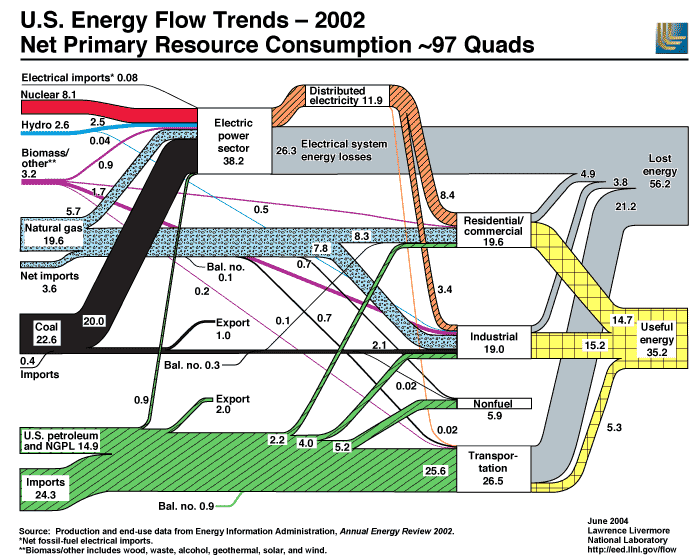
    A concept that came up over and over again was the fact that most of the energy is wasted as it is converted and used for its intended purpose. One of the most eye-opening diagrams in the book is the ‘energy squid’ first published in 1937 and updated many times since then, a version of which is shown below. It shows the flow of energy in the U.S. from start to finish and you can indeed see that most of it ends up wasted. It gives you a sense of how much energy is used just to ‘purify’ energy itself. For example, conversion of coal to electricity loses most of its thermal energy to waste heat, somewhere about 60%, which cannot be easily recovered. It also takes energy to mine and transport the coal to where it will be used. We accept this energy loss because electricity is a much more valuable form of energy than coal. For example, you can reshape the cornea of an eye with a laser. That requires electricity. You can’t do it with coal alone. So we shouldn’t be focused solely on the efficiency of energy conversion. If we do, the result could be to outlaw useful technology like lasers because they are not very ‘efficient’ if you consider efficiency simply as a ratio of energy output divided by energy input.

    The ‘Energy Squid’ showing energy flow in the U.S.
    Click on image to see larger version of it.

    Automotive engines have similar energy losses. About 65% or more of gasoline’s energy is lost in waste heat. This is simply a limitation of internal combustion engines. Also, when you take into consideration that the end result is often transporting a single person, you can make an argument that the energy to move the entire vehicle’s gross weight is wasted because if you’re moving nearly 3000 lbs of vehicle to transport a 170 lb. person, you’re wasting over 90% of the energy. So ‘efficiency’ is not a very easy concept to describe, let alone mandate or regulate. You could also make the argument that a lot of transportation, such as leisure travel, is unnecessary and therefore inefficient and should be outlawed.

    Another thing to consider is that when you make something more efficient, it lowers its cost and people end up using more of it because they can afford more of it. So chasing after efficiency often results in increased overall consumption.

    I think it is important to listen to people whose viewpoints are well researched, yet sometimes contradictory to my own. That’s how I learn. If you only pay attention to people telling you what you already know, or think that you know, you cannot become any better informed. So even if you are a self-proclaimed tree hugger, it would
    be a good idea to pick up this book and read it, so that you may better understand why everyone doesn’t believe the same things that you do. It may not change your point of view, but at least you’ll be able to evaluate the veracity of the logic behind the assertions the authors make in the book.

    Can ethanol be an aviation fuel?

    Share

    A few months ago I bought an engine for the Cozy that is a 200 HP version of the Lycoming IO-360. This engine produces about 20 HP more the standard 180 HP O-360 engine. In order to get to 200 HP, it has higher compression ratio and that requires the use of 100 octane fuel. Today, 100 octane fuel is available at most U.S. airports, but I worried about its continued availability in the future. Aviation fuel, or 100LL as it’s called, uses tetraethyl lead to increase the octane rating of fuel. Adding lead to auto fuel to enhance its octane used to be quite common but fell out of favor when it was found to distribute the lead, now recognized as a poison, into the atmosphere. Just about all countries in the world have discontinued the use of lead as an octane enhancer for auto fuel.

    I began to wonder what I might use for fuel in the future should leaded aviation fuel be outlawed, and my attention turned toward alcohol, ethyl alcohol, to be specific. It’s also called ethanol or grain alcohol and is used as an octane enhancer. It also makes gasoline burn more cleanly. Ethanol is the form of alcohol that you find in alcoholic drinks. Because of this, it is subject to liquor taxes. The only way to avoid paying liquor taxes is to add poison to it. If fuel was drinkable and available for a few dollars per gallon, it’s assumed that no one would bother buying beer, wine, or spirits. With that logic, it’s hard to understand why anyone would buy an 18-year-old bottle of scotch for $75 when Everclear can be had for $10. 🙂 This poisoning is called ‘denaturing’ and as long as it makes the alcohol undrinkable, just about anything can be used.

    It’s not unusual for auto fuel in the U.S. to contain 10% alcohol since most cars can run on fuel with this concentration of alcohol. It’s beginning to become available at 85% concentrations, called E85, but that requires that the fuel system is compatible with that level of alcohol concentration. Only a small number of vehicles manufactured over the past 10 years or so claim compatibilty with E85 and you can look up whether yours is compatible by searching for “E85 compatibility” on the Internet. Each year, more vehicles are introduced that will run on E85 or regular gasoline and these are referred to as ‘flexible-fuel’ vehicles. There’s even an effort underway to make an aviation grade ethanol called AGE-85 that is not without controversy.

    Back in the 1980s and 1990s when aviation fuel cost about twice as much per gallon as auto fuel, several efforts to qualify auto fuel in aircraft were conducted. They were targeted at older aircraft with low compression engines which were able to run on an aviation fuel called 80LL whose octane rating was close to regular unleaded auto gas. Quite a few aircraft were eligible to burn auto fuel, provided they purchased a placard called an ‘STC’ for about $200. Some airports actually began carrying it as a less expensive alternative to 100LL after 80LL went out of production. However, the tests to get approval for the STC were conducted before alcohol became a common additive to auto fuel. After it became commonplace to use alcohol as an additive, it was found that some aircraft had problems with it attacking the rubber seal materials in the fuel system. The entities that granted the STC, namely Peterson Aviation and the EAA, do not allow the use of auto fuel that contains alcohol. The octane enhancer of choice back in the 1980’s was MTBE, methyl teriary butyl ether, and it had no issues with fuel system compatibility. But it has subsequently fallen out of favor because it has environmental and health concerns. It has largely been replaced by ethanol. Adding ethanol has now become so common with auto fuel, and the difference in price between auto fuel and avgas is not as significant as it was in the 1980s so the popularity of using auto fuel in aircraft is beginning to wane.

    The IO-360 engine I mentioned earlier would not be a candidate for an auto fuel STC anyway because the octane rating of auto fuel available in the U.S. runs about 85-91 octane which is much too low and would damage an aircraft engine designed to run on 100 octane fuel. To get a fuel that had an octane rating around 100 would require using some additive. Otherwise, engine knock, also known as auto-ignition, would create multiple flame fronts that collide in the engine’s cylinders, increasing pressures and temperatures that over stress and damage the engine.

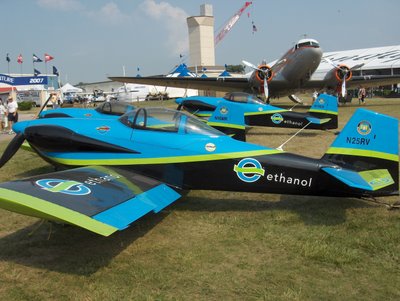
    It would appear that a solution to my concern would be to make the plane compatible with ethanol because it has an octane rating of 105. I recall seeing a group of experimental aircraft showing up at Oshkosh for many years now that all run on ethanol. They are known as the Vanguard Squadron and are shown in the image above. I tracked down one of their members, Dick Pearson, and he generously allowed me to pick his brain regarding his experience of using ethanol in an airplane. Dick has nearly 14 years of experience of using ethanol in 2 separate experimental aircraft that he flies as well as that of the other 4 aircraft in the Vanguard Squadron. He is quite a proponent of the fuel. He told me that there is a lot of controversy and misinformation floating around regarding ethanol. For example, there is a persistent belief that the energy that it takes to grow corn and convert it into ethanol exceeds the energy content of the resulting ethanol, giving it a negative energy balance. This is not true. The reason that this misconception persists is because natural gas is often used in the conversion process to provide heat for making alcohol from corn. But there’s a good reason for using natural gas for heat. The value of natural gas per BTU is much lower than it is for ethanol per BTU. It’s about a third the cost per BTU as ethanol. So even though one could use a portion of the ethanol to provide heat in the process that makes it, it’s not as economical as using natural gas for heat. It’s this business of using a fuel other than ethanol to help make ethanol that leads people to believe that it has a negative energy balance. It actually has a positive energy balance widely accepted to be around 1.34, or getting a third more energy out of the process than is put into it. That takes into consideration the energy required to fertilize, plant, irrigate, spray, harvest, transport, and convert the corn into alcohol.

    Energy balance is only part of the equation, since when you talk about energy you must consider more factors that the energy balance or cost/BTU. It’s also important to consider factors such as energy density, convenience, and fuel compatibility. This is particularly true when it comes to transportation fuels since there is high value to having a fuel that is compatible the existing engines. If energy balance and cost/BTU were the only measures of concern, we might see coal-fueled vehicles since its cost per BTU is about 10% of what we pay for gasoline.

    In Brazil where they make alcohol from sugar cane, they are able to burn the waste parts of the sugar cane called bagasse to generate the heat needed for the process. As a result, they get 10 times more energy from the sugar cane than is required to grow and convert the sugar cane to ethanol. This is similar to the energy balance expected with cellulosic alcohol.

    A number of companies are working on deriving ethanol from cellulosic plants instead of corn kernels. These materials include waste products such as wood chips, corn and wheat stalks, and other organic waste materials that have limited use today. In most cases, you have to pay someone to dispose of them. The processes that convert cellulose to alcohol are currently not mature enough to be cost competitive with making ethanol from higher-value materials like corn. However, there are a number of companies working to improve the processes and if they become competitive, it could reduce the cost of ethanol to be lower than gasoline in a direct fuel mileage comparison, and when that occurs, it has the potential to change everything.

    Some cellulose-to-alcohol processes are based on enzymes that can unlock the sugars in cellulose and convert it into alcohol using conventional fermentation. There is an ethanol plant in Canada already doing this as well as a few more under construction. There is a also a non-fermentation process developed by Range Fuels of Broomfield, Colorado that can convert cellulosic materials to alcohol. Range Fuels is building a cellulose-to-ethanol plant in Georgia that will be capable of producing 100 million gallons of ethanol a year from wood chips. I think this will substantially change the perception that ethanol is nothing but a farm subsidy, which is the view a lot of people have about it today. Can you imagine a lawn service where they reduce the fee if you let them take away the lawn clippings, leaves, and other yard waste? I think that would be a huge step in the direction of energy independence because recovering energy from local waste materials would reduce an energy supply chain that currently extends around the globe to a short loop within your own neighborhood. It would also reduce CO2 emissions because plants generally release their carbon back into the atmosphere in a relatively short time, and so instead of digging up carbon that has been buried for millions of years, we’d be able to use carbon that was essentially on its way back into the atmosphere anyway. [UPDATE 2014-02-26] Range Fuels burned through $234M in capital, about a third of it from taxpayers, before shutting down operations in 2011.

    There are a lot of competing and complementary renewable energy technologies under development including wind, solar, and biomass. I don’t think that there will be a single winner in the race to replace our convenient yet exhaustible fossil fuels. I feel a lot more optimistic about it after doing my own investigation of alternatives like ethanol instead of listening to pundits arguing for or against it, because it doesn’t take long for people to get emotional about their point of view when it comes to renewable energy. I guess that’s because mixing politics with science can be such a volatile combination. Now if only that volatility could be converted into usable energy our future would be secure!


    Colorado’s Wind Farms

    Share

    About 5 years ago wind farms started popping up in Colorado. They are easy to spot from the air and can be seen for many miles because the structures are so enormous. A modern wind turbine can reach well over 400 feet into the air.

    Over a span of less than 3 decades wind turbines have increased from an average rotor size of 10 meters generating 25KW to a rotor size of 112 meters generating up to 6 MW per turbine. The 3+ MW turbines are generally installed in the ocean about 5-10 miles off shore where the wind is steady. Land based wind turbines are generally rated at less than 2 MW. Each 1 MW of wind energy is enough power for approximately 300 households based on an average U.S. household consumption rate of around 900 kWh per month. The average power available from wind turbines, also called their ‘capacity factor’, is about 1/3 of their rated generating capacity because the wind is not constant. They make their rated power in winds about 20-25 mph and will not generate any more than the rated power even when the wind increases above that speed because it would over stress the system. Above about 55-60 mph, the wind turbine will protect itself by locking its rotor so that the blades will not get damaged.

    Here in Colorado there are many locations where the wind is nearly always blowing on the plains and there aren’t any obstructions on the ground to slow it down. Other than the trees along the Platte river, there is virtually no vegetation taller than a cornstalk between here and Nebraska. And Wyoming has even higher wind and fewer trees than Colorado in the eastern side of the state.

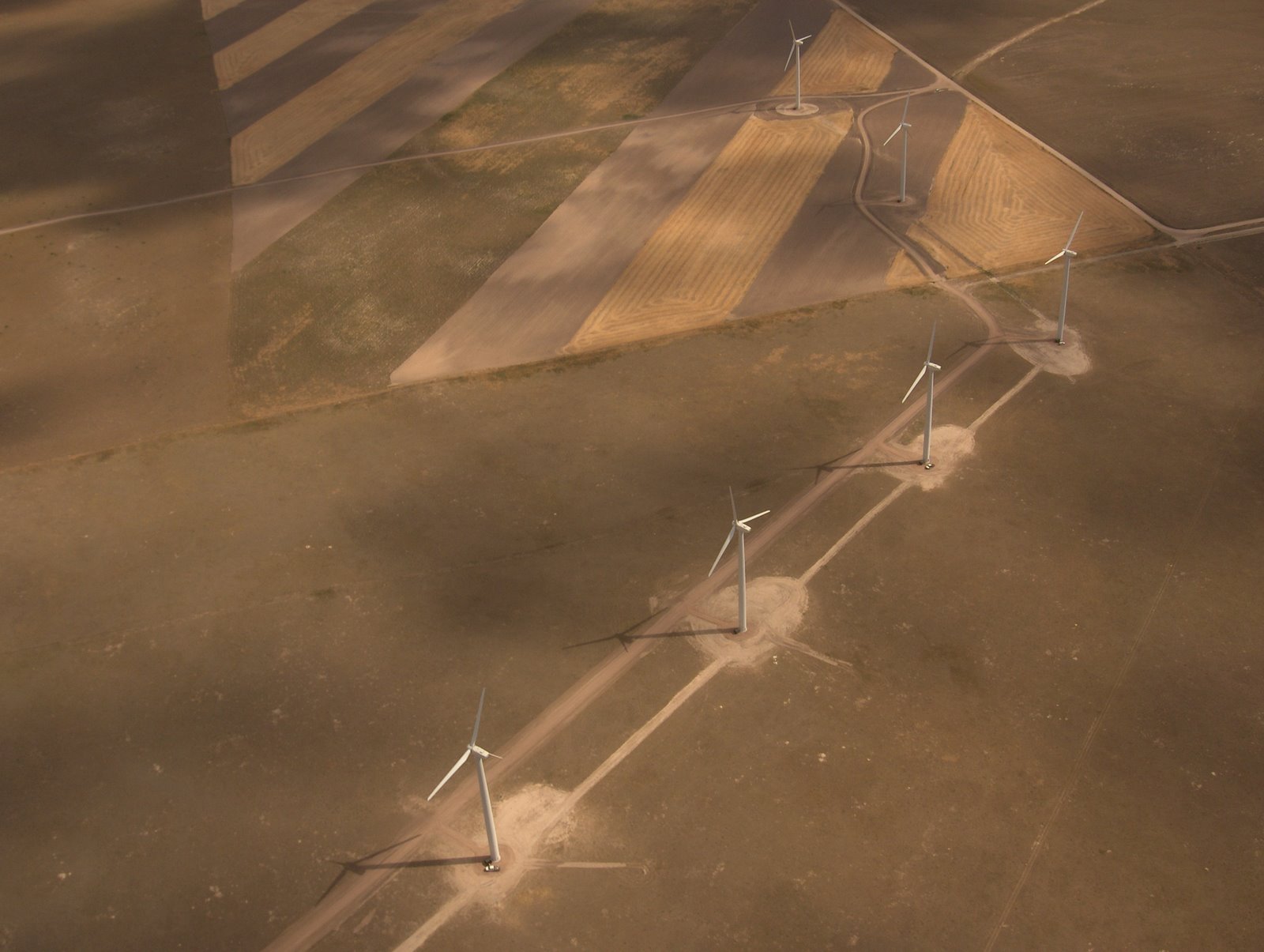
    I was out flying today and took a few photos of the Ponnequin Wind Farm up near the border of Wyoming to take a look at Colorado’s first wind farm which was built about 6 years ago. You can see a photo of it below.

    If you’re curious about the Ponnequin wind farm you can read a little about it here at the American Wind Energy Association website. If you have Google Earth, you can get a satellite view of it here. Or here on Google Maps.

    About 60 miles east of the Ponnequin Wind Farm, the largest wind farm in Colorado called Cedar Creek is currently under construction. During the past few months I’ve been monitoring the progress of it since it’s not far from Greeley, at least not as the crow (or LongEZ) flies, and I’m astonished at how fast it’s getting built. A few months ago, there were only a few towers standing and now they have more than 200+ towers erected. I timed how long it took me to fly from one end to the other and it was 5 minutes, flying at 160 miles an hour which means it stretches 13 miles from east to west. It’s on land that previously didn’t have much use due to sparse population and lack of water for irrigation. I did some quick calculations and realized that this wind farm will generate more than $80M/year in electricity from its 273 wind turbines, based on the average of around $.10/KWh currently paid in the U.S. by consumers. That’s not a bad return since the fuel, a major cost for conventional power plants, is free in the case of wind power.


    Looking down from above on these structures, it’s hard to fathom how big they are. In the picture above, the closest wind turbine has a large truck parked near its base which is virtually invisible in the photo. That gives you an approximate idea of the scale of these structures. Go ahead and click on that image to get a higher resolution photo of it and a better idea of the relative size of the truck and the wind turbine.

    One of the biggest logistical issues with constructing these wind farms is getting the materials to the site. The tower sections take up most of the highway when transported and are nearly 60 feet long per section. It takes 3 of them to make up the tower. Similarly, the rotor blades are enormous, over 100 feet in length. Can you imagine trying to get that to go around a corner?

    Vestas Wind Systems of Denmark is currently building a turbine blade plant in Windsor, CO, just about 10 miles from where I live. This will better accommodate the delivery of large turbine blades to wind farm sites in the western U.S.

    In talking with a rancher in Wyoming recently, it appears that a lot of site surveys have been underway over the years to construct wind farms there, turning what was very marginal land into a valuable resource to provide clean, renewable energy for future generations. Even though the Cedar Creek site seems expansive, and it is, there is so much land in eastern Colorado and Wyoming that would be ideal for wind farms that it’s easy to imagine building them for the next 20 or 30 years. That’s about the average life expectancy of the wind generating equipment, so after they’ve done that, they will get to do it over again.