

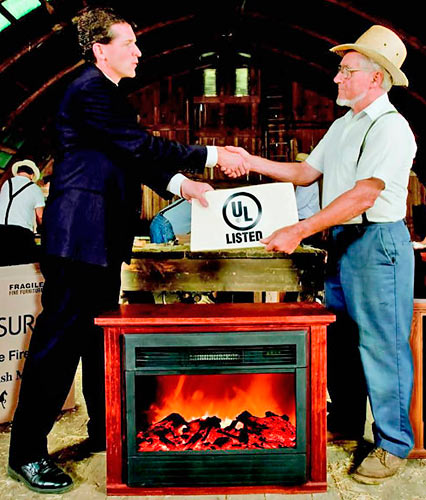
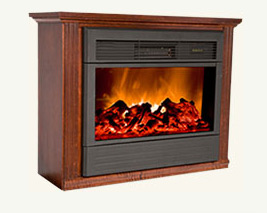
I saw a two-page ad in the Rocky Mountain News this week about some new miracle heater called the ‘Amish Heat Surge‘ and it fell into the category of things that sounded to me to be ‘just a little fishy’. Later I saw a commercial for the same product. Sure enough, after doing some calculations, I figured out that this is just a scam to overcharge people for a cheap electric heater made in China. Searching the Internet, I found a few unhappy customers who fell for it. Even though the heaters are ‘free’, you pay $298 for the ‘Amish authentic wood mantles’ that enclose them. In reality, there’s no reason to wrap an electric heater with a wooden box or mantle. It also has some sort of fake fire effect. Oh, and shipping costs $50 EACH. And they’ll stick you with an extended warranty for $28 each. So for around $770, you’d get a pair of heaters that do the same thing as a pair of $27 electric heaters you can pick up at Wal-Mart.
A 5,119 BTU/hr heater generates about 1/20th the heat produced by a household furnace. It will draw 1.5 kW. For every hour this thing runs, it will cost about $.15 in electricity, which doesn’t sound like a lot, but over a 730 hour month, that adds up to an extra $108 on your electric bill. Electric resistive heat is the most expensive way to heat a house. It costs about twice as much per BTU as natural gas heat. Just to put it in another perspective, a 2,100 sq. ft. house in my home state of Colorado uses about 6 therms of natural gas a day in the coldest winter months. At the current gas price of $1.20 per therm, a typical gas bill is $216/month during the winter months. To heat your house to the same temperature with this electric heater, you’d need to have 5 of these heaters operating at the high setting 24 hours a day. The additional monthly charges on your electric bill for just the heaters would be $540!

The ad talks about only using it to heat zones, which can save on your heating bill, of course, but only at the expense of having some of the rooms in your home being uncomfortably chilly. And you can’t really completely turn off your central furnace without the risk of pipes freezing. In other words, if you put a heater like this in the room that has your furnace’s thermostat, and thus your furnace never comes on, you may freeze pipes in a remote part of the house.
The ad is full of high pressure sales nonsense, such as requiring a special savings code that expires in 48 hours, or you’d otherwise pay $587 each! There is a limit of 2 per household and they need to ‘turn away dealers’ because they can’t keep up with demand.
If you’re one of the people reading this article who bought an Amish Heat Surge heater, please note that I mean no disrespect to you. I’m just tired of con artists using slick advertising to suck people into buying things that aren’t worth a fraction of the sales price.
This ad is so funny they should charge for it. I am sorry for anyone who fell for this ridiculous song and dance but that video is pricless! The Amish working in the barn, the craftsmen with the level, and my favorite, the horse drawn carriage pulling away from the barn with a heat surge in back. Like many others have said, 1500 watts is 1500 watts, end of story. I’m an engineer so I’m able to pick this up a little easier than most, but come on folks! I see they are being sued, I’m going to miss their hokey infomercial on cable TV. http://www.11alive.com/money/consumer/story.aspx?storyid=175896
I also bought one of these heaters, and just yesterday was telling my sister in Akron, Ohio about it. She asked if they were Chinese amishmen!!! Akron is the town right next to Canton, Ohio were the heaters are made. Today she called to tell me that there was an article in the Akron Beacon Journal about a class action lawsuit being filed against Heat Surge in Cleveland. If you type in Heat Surge Class Action Lawsuit; you can read the article from the Canton Repository. Would like to find out more info on the lawsuit.
I just wanted to make a quick comment regarding the authenticity of “Amish-Made”
True, many Indiana RV companies employ Amish workers. They do, however, employ Mexicans, Blacks, Blue People ect.
Therefore the claim that an English owned (meaning non Amish) company is indeed “Amish Made” is not only wrong, but politically incorrect as well.
For example, if your Ohio-owned company employs Amish (not that uncommon) you cannot claim that your product is “Amish-Made” It would be the same if you employed Mexican workers. You would not be able to claim that your products are “Mexican Made”. You, yourself, would have to be Amish or Mexican to state that claim.
I live in Rural Wayne County Ohio and have so for years. It is very common for “English” businesses to employ Amish workers. Likewise, many “Amish-owned” businesses do not use or practice the use of electricity.
Also, keep in mind, that there are at least 8 orders of Amish (range from fairly progressive to conservative). Each order practices nearly the same belief in God but have separate ideas on daily conduct.
This is the niche that has been coveted for years in furniture making: hand-made furniture has always been associated with the Amish and companies like this disrupt this idea. True “Amish-Made Furniture” is indeed hand-made with the lack of power tools. What this company is selling you is a piece of laminate particle board made by Amish employees of an American company.