

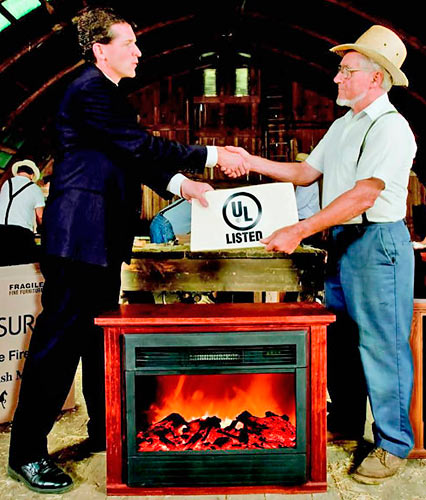
I saw a two-page ad in the Rocky Mountain News this week about some new miracle heater called the ‘Amish Heat Surge‘ and it fell into the category of things that sounded to me to be ‘just a little fishy’. Later I saw a commercial for the same product. Sure enough, after doing some calculations, I figured out that this is just a scam to overcharge people for a cheap electric heater made in China. Searching the Internet, I found a few unhappy customers who fell for it. Even though the heaters are ‘free’, you pay $298 for the ‘Amish authentic wood mantles’ that enclose them. In reality, there’s no reason to wrap an electric heater with a wooden box or mantle. It also has some sort of fake fire effect. Oh, and shipping costs $50 EACH. And they’ll stick you with an extended warranty for $28 each. So for around $770, you’d get a pair of heaters that do the same thing as a pair of $27 electric heaters you can pick up at Wal-Mart.
A 5,119 BTU/hr heater generates about 1/20th the heat produced by a household furnace. It will draw 1.5 kW. For every hour this thing runs, it will cost about $.15 in electricity, which doesn’t sound like a lot, but over a 730 hour month, that adds up to an extra $108 on your electric bill. Electric resistive heat is the most expensive way to heat a house. It costs about twice as much per BTU as natural gas heat. Just to put it in another perspective, a 2,100 sq. ft. house in my home state of Colorado uses about 6 therms of natural gas a day in the coldest winter months. At the current gas price of $1.20 per therm, a typical gas bill is $216/month during the winter months. To heat your house to the same temperature with this electric heater, you’d need to have 5 of these heaters operating at the high setting 24 hours a day. The additional monthly charges on your electric bill for just the heaters would be $540!

The ad talks about only using it to heat zones, which can save on your heating bill, of course, but only at the expense of having some of the rooms in your home being uncomfortably chilly. And you can’t really completely turn off your central furnace without the risk of pipes freezing. In other words, if you put a heater like this in the room that has your furnace’s thermostat, and thus your furnace never comes on, you may freeze pipes in a remote part of the house.
The ad is full of high pressure sales nonsense, such as requiring a special savings code that expires in 48 hours, or you’d otherwise pay $587 each! There is a limit of 2 per household and they need to ‘turn away dealers’ because they can’t keep up with demand.
If you’re one of the people reading this article who bought an Amish Heat Surge heater, please note that I mean no disrespect to you. I’m just tired of con artists using slick advertising to suck people into buying things that aren’t worth a fraction of the sales price.
Yet another thanks you for posting this information. I miss my real fireplace so much, the glowing fireplace ads did attract me. Was about to toss an old (Sept 30th NYT) this morning when spotted full page ad run in that issue. Discovered your article — many thanks.
Especially the link to Holmes Ceramic Heaters —
Guess I just have to part with yearning for cozy flameless fire… Sorry NYT, and National G are so hard up for ad dollars that they would run ads from scam outfits as this one clearly is.
– Grateful Unrooked Senior
They sell you an Amish heater that is scratch or dent…..don’t believe them! When it arrives it is a refurbished heater; not scratch or dent. Apparently they don’t know the difference between refurbished and scratch or dent. Don’t believe anything this company tells you!
When I first saw the newspaper Ads for these heaters, the one in the foreground, being “worked on” by one of the Amish men, appeared much larger than all of the others in the barn.
Again, a PhotoShop trick to get you to believe that the unit is of a substantial size.
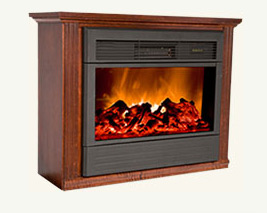
In actuality, the unit is about 3′ long by 2′ high, and about 12″ deep, The wood is stained to resemble either oak or cherry, but is not a genuine species of that tree. Another “First” for Made in China.