Colorado Wind Energy

Share


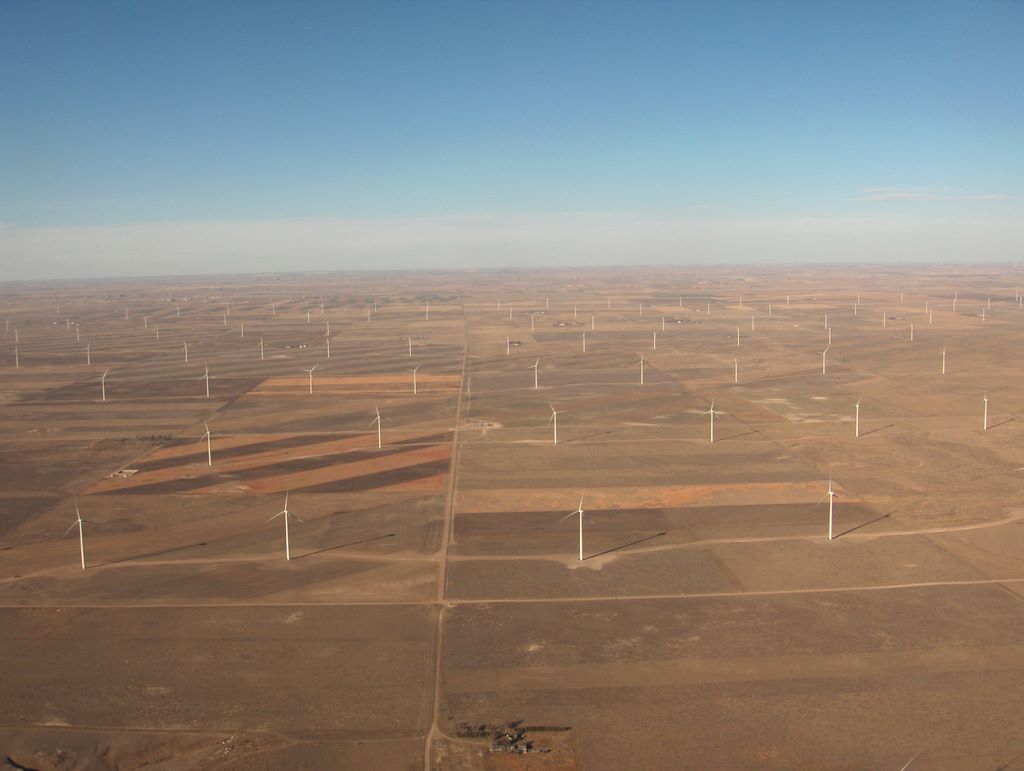
I was out last week flying in the LongEZ and I decided to check the progress of the large wind farms that are under construction in Northern Colorado. One of these wind farms called Cedar Creek is right at the Wyoming-Nebraska-Colorado border and the other is farther east in Colorado, just south of Sidney, Nebraska. It is called the Peetz Table Wind farm. Between them, they have 500 wind turbines with a peak generating capacity of 700MW.

One of the things that impresses me most about wind farms is how fast they get built. These two facilities were just in the discussion stages 2 years ago. Early this spring they were just setting up the towers and now all towers are nearly complete and generating power. When I was growing up in Pennsylvania, nuclear power projects like the Susquehanna Steam Electric Station took a very long time to build, with an average build time of 12 years. By contrast these wind projects are going up in a year or less, and the amount of land available on which to build them is substantial so I would expect to see many more going up over the next few decades. Out west we also don’t have nearly the number of people objecting to them with NIBMY excuses. I suppose when your closest neighbors include 220 Minuteman silos, you have a different perspective on what constitutes a “good neighbor.” Some people can be very picky about what they allow in their backyards, as evidenced by Cape Wind.

My previous blog posting on Colorado wind power included an aerial shot of Colorado’s Ponnequin wind farm near Cheyenne, and I now have some new photos of the new wind farms I mentioned, each which has more than 200 wind turbines.

There are also some photos of the new Vestas Blades factory which is under construction in Windsor. It will produce about 1200 40-meter wind turbine blades per year when it is completed next spring. They are even talking about expanding it to increase the rate of production by 50% within a year of commencing operation.

Blending E85 at the pump

Share

I previously wrote about using ethanol as an aviation fuel. After noticing that the national average for aviation fuel is now around $4.60/gallon, and E85 is available for $2.19/gallon, it seems fitting to revisit the subject. As oil heads toward $100/barrel, pushing regular gasoline over $3/gallon again it would seem that E85 is poised see some renewed interest at the fuel pumps around the country.

In order to take advantage of E85’s lower pricing in comparison to gasoline, it requires that you have a ‘flex-fuel’ vehicle that is approved for use with E85…or does it? I began to ponder the question of whether you can safely run E85 in a vehicle that is not specifically designed for it. I decided to do some research and experimentation on the subject. There is a lot of misinformation floating around about ethanol, much of it by people who don’t have the slightest understanding of fuel chemistry. It’s sometimes so often repeated that you have to wonder if there is some sort of conspiracy against ethanol. I have a little more experience than the average man off the street about gasoline and ethanol. I worked in HP’s Chemical Analysis group for 7 years (now part of Agilent Technologies) where one of the instruments I helped to design and support measured oxygenate content in gasoline. So I am constantly amazed at how people with no technical background in the subject will confidently repeat common myths about ethanol. I covered a few of those in the aviation fuel article so I won’t repeat them here.

I was interested to know if anyone had developed a kit to convert a conventional car into an E85 flex fuel vehicle. I found that there are several conversion products on the market that splice into a car’s fuel injection system that allow any fuel-injected vehicle to use E85 fuel. Just about all cars manufactured in the past 15 years use fuel injection systems instead of carburetors to adjust the air-to-fuel ratio to the engine. The advantage of fuel injection is that it can be computer-controlled to vary the air-to-fuel ratio based on a number of factors such as throttle position, engine speed, manifold pressure, engine temperature, and oxygen content of the car’s exhaust. The ability to monitor all of these parameters and adjust the mixture accordingly has helped significantly with advances in fuel economy and emissions reductions. The computer is able to adjust the fuel amount by pulsing the fuel injection valves to allow just the right amount of fuel to enter the intake manifold. The air-to-fuel ratio is thus determined by how many milliseconds the injector valve is opened each cycle. By monitoring the oxygen content in the exhaust, it’s possible to tell whether the fuel injectors are providing too much fuel (too rich a mixture) or too little fuel (too lean a mixture) and that information can be used to help close this control loop. Although I haven’t been able to find any technical descriptions on the theory of operation of these conversion devices, the only thing that one can assume that they do is to stretch the pulse generated by the car’s computer to compensate for the air-to-fuel ratio difference required by E85 to extend it beyond what the car’s computer had included in the lookup table for the air-to-fuel ratio settings. It needs to do this because the air-to-fuel ratio for ethanol is about 30% lower than it is for gasoline. So the effect of adding one of these devices to your car is to shift the lookup table to favor E85 fuel in the event that the standard lookup table cannot reach the lower air-to-fuel ratio required to keep the mixture rich enough when running ethanol.

I would estimate that the cost of the electrical components to implement a simple scheme like this would be well under $50, and so you would think a conversion kit would sell for somewhere around $150 or less, but they are charging as much as $500 to $750, which is more that I wanted spend to run some E85 experiments. So I won’t be discussing the efficacy of E85 conversion kits. Instead, I will concentrate on blending ethanol with gasoline at the pump.

Ethanol has about 28% less thermal energy (measured in BTUs) than gasoline. However, the process to convert the BTUs into mechanical energy on cars is rather inefficient, usually less than 30%. Thus it doesn’t automatically follow that your fuel economy will be reduced by exactly 28% when you run E85 in place of gasoline if you can improve the conversion efficiency. In fact, E85 may deliver similar fuel mileage if your car’s computer can advance the timing of the ignition and convert more of the BTUs into usable mechanical energy. This is possible due to ethanol’s superior octane rating, which is a measure of resistance to engine knocking, also known as ‘pinging’ or detonation.

E85 has a 105 octane rating, which exceeds the octane rating of even the most expensive premium gasoline by a wide margin. For example, in Colorado we have 3 commonly available grades of fuel: 85 octane, 87 octane, and 91 octane. These are lower than what you’d find at sea level because at Colorado’s higher altitudes, the risk of detonation is lower and thus you can safely use lower octane fuels

Gasoline’s price goes up with increased octane rating because of its higher ‘grade’ and to cover the expense of the blending agents required to enhance the octane rating. I’ve noticed that the price goes up approximately 7% per grade here in Colorado. I’ve often wanted to use 85-octane gasoline since that’s the lowest price for fuel advertised on the gas station signs, but I know how destructive detonation can be to an engine, so I always use at least 87 grade on my Dodge Durango. On the few occasions I tried 85 octane, I could hear the tell tale signs of knocking when climbing hills. The knocking goes away in a few seconds since the computer is able to monitor a ‘knock sensor’ on the engine and retard the ignition timing accordingly but I still don’t like to hear that sound so I stick with 87 or higher octane.

I noticed that there is a rather extensive Wikipedia article dedicated to using E85 in standard engines. Although there are a number of warnings about all the things that could happen when running E85 in a vehicle not specifically designed to run on E85, most of them don’t apply to vehicles manufactured after 1990. For example, much of the rubber seal material in automotive fuel systems was changed after ethanol became a common blending agent. Ethanol is typically mixed at the rate of 10% ethanol to 90% gasoline to help reduce emissions, and most cars can run fine on a mixture with as much as 20% ethanol. I became curious to see what would happen if I tried running on 30% ethanol, so lately I’ve been filling my tank w
ith 2/3 of the less expensive 85 octane gasoline mixed with 1/3 of E85. This gives me something close to a 30% ethanol ratio (E30) with an expected octane rating of around 91 and a BTU content that would be 90% that of gasoline. Since I’m saving 7% per gallon on the gasoline, and 30% per gallon on the E85, my fuel bill effectively is reduced by about 15%.

I have a fuel computer in my Durango that gives me instantaneous and average MPG and I’ve noticed about a 10% drop in MPG on my E30 blend, so it’s still about 5% cheaper to do this than to fill up with regular gas.

I’m not blending my own E30 for the savings, but rather to satisfy a curiosity about using ethanol. I suppose if one is of a mindset to reduce our nation’s dependence on fossil fuels, blending in E85 at the pump could have an immediate impact of reducing our demand for gasoline by about 30%, or 40 billion gallons per year while increasing the demand for ethanol by a similar amount. The ethanol industry doesn’t produce enough to satisfy this level of demand yet, but if more people started blending E85 with regular gasoline at the pump it may help to drive demand for E85 to help to increase its availability. One of the common shortcomings of E85 is the fact that it’s only available in a relatively small number of locations. For example, in my own town of about 77,000 people, we have only two stations that carry it.

What I’d really like to do is reprogram my car’s computer, often referred to as the ECU (engine control unit) or PCM (powertrain control module), to accommodate E85. However, the information to do something like this isn’t readily available. If you’re an automotive engineer with Daimler-Chrysler and know how to reprogram the ECUs to be E85 compatible, please contact me ;-).

My nephew is currently in the process of installing an open source-based ECU called a MicroSquirt II in his 1981 DeLorean and I have become his technical support hotline, giving him tips on proper soldering techniques and electronic debugging issues with the device. The more I read about it, the more I like the idea of a completely user accessible and reprogrammable ECU. That would make it easy to experiment with various ethanol ratios and once it’s debugged, the data could easily be made available to anyone with a similar vehicle who wants it.

The EPA is concerned about aftermarket products in this category, of course, because the ECU is largely responsible for keeping the tailpipe emissions compliant with clean air regulations. But I see that as a relatively easy problem to solve because using oxygenated fuels such as alcohol and reducing tailpipe emissions tend to be mutually compatible goals. The EPA has issued laws against altering the ECU in a way that makes the vehicle non-compliant with clean air standards. This was a problem when people were converting cars to run on propane and natural gas back during the first energy crunch but today I think those laws are mainly aimed at companies selling ‘performance chips’ which tend to sacrifice fuel economy and tailpipe emissions for more power.

It will be interesting to see what happens with E85 because the stock market seems to be predicting a glut of ethanol in the near future, but with the recent increase in gas prices it may take care of any potential ethanol over supplies, especially if the idea of using it in standard vehicles becomes popular.


Cape Wind

Share

I recently read a book entitled Cape Wind by Wendy Williams and Robert Whitcomb. It’s a book about the struggle to get approval to build America’s first off-shore wind farm. I have been writing about wind energy lately because I think it has reached a critical mass and it is has the potential to grow to power a large part of America’s electrical grid in the next few decades. In Denmark, wind energy is already producing 20% of that country’s electricity needs.

What’s interesting about Cape Wind is that it’s become such a controversial project. You’d think that something that provides clean and renewable energy to an area of the country that desperately needs more electrical generating capacity would be anything but controversial, yet this is not the case. The controversy stems from the location for the wind farm in Nantucket Sound, which is about 5 miles off the coast of Cape Cod. For the past 6 years, this project has been held up by people who have gone to great measures to make sure it does not get built. What makes it more interesting is the reason they don’t want it to be built. Quite simply, they don’t want to have to look at it. In other words, it offends their sense of aesthetics. Stating this objection publicly would not help their cause so they are using flimsy but less embarrassing excuses such as their concern for wildlife, fisherman, pilots, and a whole host of reasons that are diversions from the real reason, that is, people feel that views from their mansions are off limits for any other societal benefit besides their own viewing pleasure. Nantucket Sound is best viewed from private beaches attached to multi-million dollar estates.

The power from the wind farm could provide up to 75% of the electrical energy needs for Nantucket, Martha’s Vineyard, and Cape Cod. The power for this region is currently generated by a dirty oil-fired plant that has been responsible for several oil spills further down the Cape Cod coast.

The location for the proposed wind farm is ideal because it has excellent wind conditions and it is a shoal, which means it is shallow, making construction much less expensive. It’s actually too shallow to sail yachts in that location during low tide. The wind farm would only be visible from the shore for 1/2 inch above the horizon and only on clear days.

What makes the resistance to the project even more newsworthy is that it is opposed by politicians who claim to be staunch environmentalists such as Robert F. Kennedy Jr., Ted Kennedy, and Mitt Romney. The wind farm is supported by 84% of Massachusetts residents and yet a powerful and elite group is trying to subvert the democratic process by imposing their own will on that of the majority. Since the plant would be located in federal waters, each American should have an equal say in its approval, not just wealthy beach front property owners.

My main concern about the resistance to Cape Wind is that of setting a precedent that wind farms are something people should not want to have in their ‘back yards’. Cape Wind could be a showcase of environmental stewardship. By resisting wind energy, these people are increasing the likelihood of someone else getting a coal-burning power plant in their back yard and that’s not a behavior I want associated with fellow Americans. After all, Europeans have been building off shore wind farms for many years with great success.

People need to understand that clean and renewable energy is necessary to maintain our standard of living, protect the environment, and reduce our dependence on exhaustible fossil fuels. When you look upon a wind farm with those thoughts in mind, it connects with a much deeper sense of aesthetics than the superficiality exhibited by Cape Wind’s opponents.

Perhaps this report from Comedy Central helps add a bit of levity and puts the opposition to Cape Wind in perspective:

I sincerely hope that this project gets approved and built. Not only would it help to solve the Cape’s energy shortfall, it would restore my faith in democracy. It would also help send the message that making up questionable excuses to resist the construction of renewable energy projects is a fool’s errand.

You can keep abreast of this critical project at Wendy Williams’s blog.

Wind power in Pennsylvania

Share

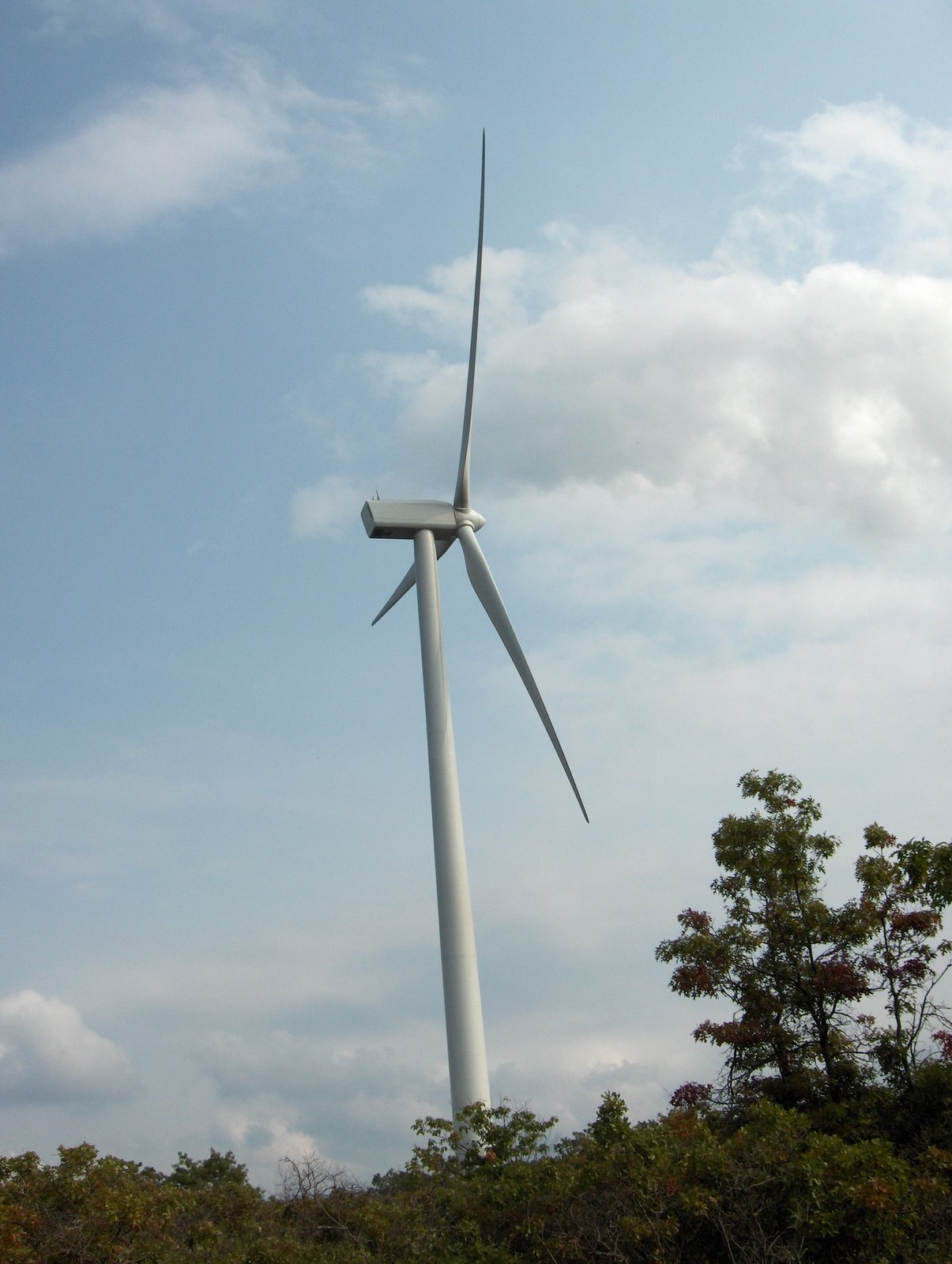
I traveled back to Pennsylvania last week for my high school reunion. As you may have noted from some of my recent posts, I’ve been investigating energy, particularly renewable forms of energy. It had been three years since we’d been back in the Wyoming Valley and so I was quite astonished to see 12 large wind turbines plainly visible on top of the eastern ridge of the valley up near Bear Creek. Each 2MW Gamesa turbine provides enough electricity for about 600 homes.

I’ve written about wind turbines before in my blog because they started springing up in Colorado a few years ago and whenever I travel across Nebraska and Iowa in the LongEZ, I seem to find more of them each year.

I had yet to get up close to a wind turbine so Terri and I decided to take a drive up to the site. As you may know if you’ve ever traveled around this area of the country , the closer you get to something, the harder it is to find. In other words, you can’t see the forest through the trees. We drove up Route 115 into Bear Creek and the wind turbines all but disappeared behind the mountains and trees. We continued to drive in the general direction of the turbines, and every once in a while, we’d catch a glimpse of a blade to help reorient us toward the wind farm. After driving in a circle, we eventually found the access road to the wind farm, just off Bald Mountain Road. We saw a lot of no trespassing signs, but felt it wouldn’t hurt to go up to the maintenance office to see if we could get permission to drive up to the first tower. I found a friendly engineer there and we began to chat and he said we could drive up to the first tower and take a look around. I was most interested to hear one of these wind turbines from up close.

We were able to get quite close to the turbines and found that the noise they made was hardly noticeable and certainly not objectionable. I asked the engineer why there is controversy when it comes to wind turbines and he felt that people have been conditioned by those who have a vested interest in non-renewable forms of energy attacking them for various reasons that border on being ridiculous. For example, a common objective I hear is that wind turbines kill birds. More than 100 million birds are killed each year flying into windows in the U.S. alone, yet you don’t see anyone trying to ban windows. A similar number are killed by house cats and cars. Wind turbines kill only 1 or 2 birds per turbine per year. Even with the thousands of wind turbines deployed and planned, this number will always be at least 3 orders of magnitude less than the other causes I listed, and so bringing up one’s concern for the well being of birds is a rather odd objection.

Opponents also say that wind turbines kill bats, which eat mosquitoes, that may carry West Nile virus. Again, I think this is really reaching by people who are unaware of the benefits of renewable energy and afraid of any unlikely downside potential, such as lowered property values. I’ve also heard of people fearful that wind turbines cause audible noise but I can attest from my own experience that the noise was not very noticeable. I’d gladly trade wind turbine noise for the noise that comes from the highway 1/4 mile from my house.

I can understand the people who live a few hundred feet from a wind farm being concerned about noise, but I grew up less than 300 yards from a working coal breaker that operated 24 x 7 and it made quite a racket, yet I never knew of anyone complaining about it. It also released plenty of coal dust into the local environment as well as the final product which has significant environmental hazards. So maybe I have a different perspective on environmental noise and pollution than someone who has built a house on a mountaintop.

On the way back down the access road, we came across a large flock of wild turkeys crossing the road which you can see in the picture below. Click on it for a better image of the turkeys.

Later in the week, we traveled up to Scranton and saw the Waymart Wind Farm which has 43 GE 1.5MW turbines.

I think that wind farms along the ridges of Pennsylvania will become a more common sight as time goes on. People should not consider wind turbines as eyesores, but rather see them as examples of majestic beauty that benefit all of society.

I believe people will come to understand we need to eliminate our dependence on exhaustible fuels to provide our electricity. There is no argument that we will run out of them eventually. At some point people will realize that when they turn on a light, a TV, or computer, the energy may be coming from a silent wind turbine spinning in the distance powered by a clean and inexhaustible energy source.